
Understand the measured quantity before relying on a single score

What does an air quality sensor measure, and what does it not show?

The term air quality sensor does not describe a single sensing method. CO₂, responses to volatile organic compounds and particulate matter are monitored with different sensors. A device's eCO₂ reading must not be equated with direct CO₂ measurement, nor a VOC index with the concentration of a specific gas. VOMRO develops customer projects combining purpose-appropriate sensors with a circuit board, embedded software, airflow path and data display.

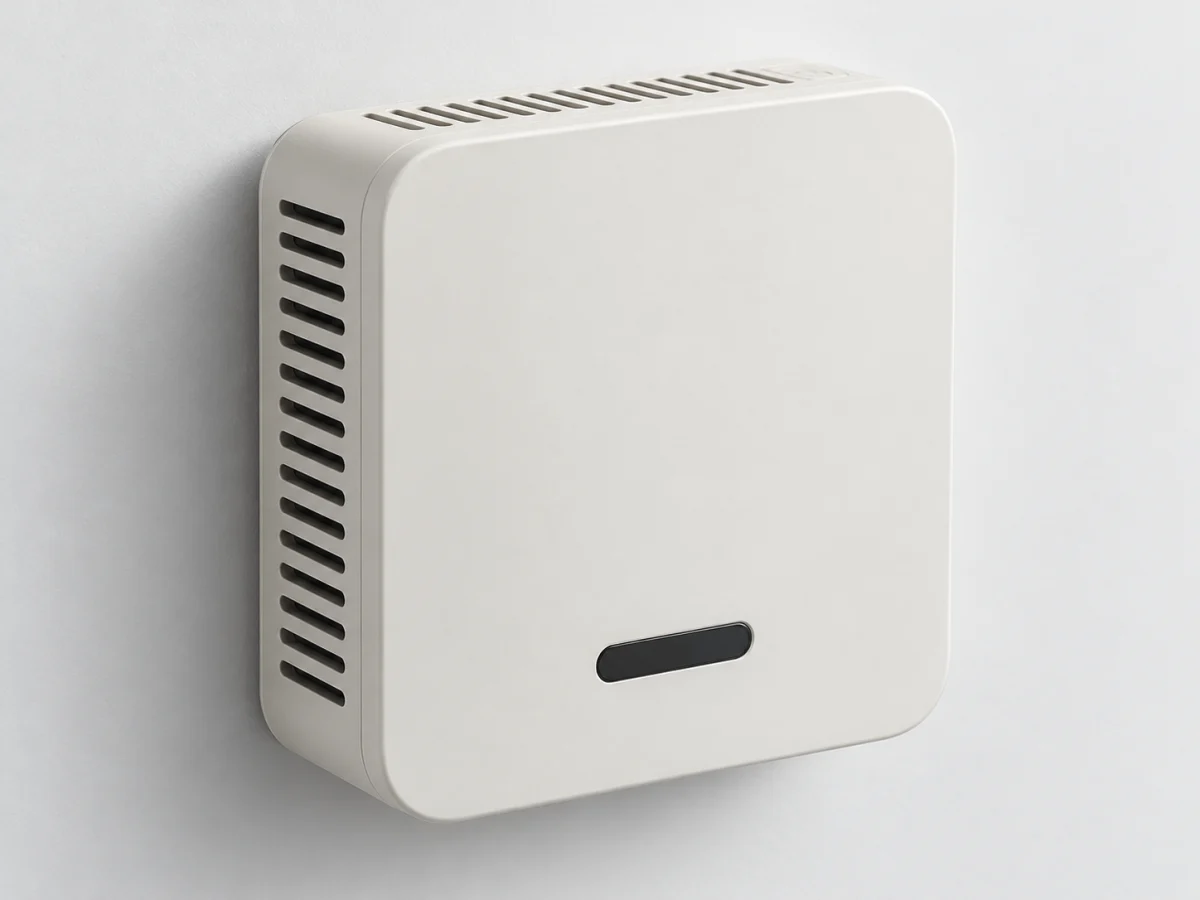
Completed air quality sensor with air inlet openings and an enclosed white housing
Illustrative sensor product image.
Separate measurementsCO₂, VOCs and particulate matter
Data definitionUnit, method and validity
VerificationActual airflow path and representative records

VOMRO engineering approach

Start the measurement project with the decision it needs to support.

Monitoring changes in a meeting space, comparing the inlet and outlet of a filtered device and measuring a specific gas in production are different tasks. Before listing sensors, define the event to observe, the recording timescale and who will use the data. Build a measurement arrangement that answers the question rather than adding unnecessary channels.

The EPA states that low-cost monitors detect only the pollutants or environmental factors they are designed to detect. A single sensor therefore does not provide a complete result representing the entire indoor environment. Each channel's name and limitations should be clearly shown in the interface.

The complete measurement process

From sensed quantity to usable data

  1. 01Representative air sample
  2. 02CO₂, PM or VOC channel
  3. 03Separate interpretation for each channel
  4. 04Explainable data with units

Conceptual diagram. The actual measurement range, error budget and validation plan are defined for the application.

01

What is the main difference between CO₂ and eCO₂?

CO₂ measurement requires a sensing principle responsive to the target gas. In the Sensirion SCD4x example, a photoacoustic NDIR approach provides CO₂ concentration in ppm. eCO₂ or CO₂eq can instead describe an equivalent output derived from other gas signals and a model. Showing the same unit on a display does not make the methods interchangeable.

This distinction matters when reusing a purchased module. Check whether the CO₂ label on the existing display matches the sensor's actual output. Add the channel type and sensor model to the measurement record. Where actual CO₂ is required, do not select a module using an equivalent output; the data schema and interface label must reflect that decision.

02

Does a VOC index indicate the amount of a particular gas?

VOC is a collective term for volatile organic compounds. Depending on the model, a gas sensor's processed output may be a TVOC signal or a VOC index. Sensirion's migration guide explicitly distinguishes the SGP30's TVOC and CO₂eq outputs from the SGP40's VOC index produced by an external algorithm; this is a software change as well as a component change.

If the project is intended to monitor changes caused by cleaning, production or device use, record example events first. Store the index name, initial conditions and software version with the result. If a selective concentration measurement for a particular chemical is required, do not assume a general index will meet the need; investigate a method specifically for that target.

03

Why is PM measurement separate from gas measurement?

Particulate sensors examine airborne particles; they do not replace CO₂ or VOC channels. The SPS30, for example, uses laser scattering and provides separate mass and number concentration outputs. Manufacturer documentation also states that some size groups rely on a calculated distribution. The output type and unit must therefore be understood alongside the PM label.

Using two sensors in a filter trial does not by itself define the test method. First determine inlet and outlet positions, simultaneous logging, matching operating conditions and the sensor comparison setup. Recheck results after changing airflow or adding an enclosure. The report should explain this arrangement as well as show graphs.

04

How are the airflow path and sensor location determined?

The EPA recommends unrestricted air access when positioning monitors and considering the effects of nearby sources and air currents. A device monitoring general room trends and one placed immediately beside a source answer different questions. Without a documented placement purpose, two correct measurements may be wrongly regarded as contradictory.

The design review maps sensor compartments, air openings, fan operation and maintenance access. Prototype tests record at several locations to assess whether the chosen position represents the target. The operating state of electronics beside the sensor is also logged. The open prototype and enclosed device are compared before the mechanical design is finalised.

05

What should a multisensor board and software record?

It is useful to define a separate data contract for each channel: quantity, unit, scale, reading time, readiness and error state. Since different modules may behave differently at startup, we do not treat all readings as valid immediately after power-on. Sensor drivers, measurement timing and state machines are developed according to the selected components' documentation.

The user display distinguishes old data, invalid data and zero values. We plan how local recording continues during network loss and how chronological order is preserved when data is transferred later. Filtering and averaging settings can remain traceable without deleting raw data. This allows investigation of whether a field change originated in the sensor, communication or presentation settings.

06

What should the calibration and comparison plan include?

The CO₂ module manufacturer's support page provides separate testing and design-in guides. This distinction matters in practice: communicating with a development board does not validate measurements in the finished device. Device records should identify which manufacturer correction is used, the conditions it requires and the version of any change.

Project tests plan for candidate devices to operate simultaneously in the same environment, comparison against a selected reference and logging of repeated events. The comparison range, reference method and acceptable deviation are defined before testing. Results include data loss, transition behaviour, startup time and environmental changes, rather than only an average value.

07

Common interpretation errors and an effective project brief

Key errors include labelling eCO₂ as actual CO₂, treating a VOC index as the ppm concentration of one gas and interpreting PM data as gas concentration. If a combined air quality score is provided, its calculation is explained and access to individual channels is retained. A colourful display should not conceal the method underlying the measurement.

For an initial discussion, share the quantities to monitor, how the space is used, device position, power and communication conditions. Logging duration, target quantity, service expectations and the reference setup also define the scope. VOMRO can address sensor selection, custom boards, embedded software, enclosures and pilot validation together according to the project; product outputs are defined through a technical acceptance plan.

  • Distinguish CO₂ and eCO₂ labels.
  • Show units and data validity for each channel.
  • Compare at the same time and under the same environmental conditions.
Air monitoring channels are not interchangeable
ChannelMeaning of the outputDo not confuse with
CO₂Concentration measured using a method appropriate to the target gaseCO₂ / CO₂eq estimate
eCO₂Equivalent value calculated from another gas signalDirect CO₂ measurement
VOC indexAlgorithm-processed indicator of VOC changesSelective concentration of a single gas
PMParticle mass or number concentrationGas and vapour measurement

How it works

A clear process from start to delivery.

Not every project looks the same; however, the measurable requirement, controlled revision, and field verification steps remain unchanged.

  1. 01

    Clarify the question

    We determine which quantity will support which decision.

  2. 02

    Select the channels

    We compare the sensing method, output type and placement together.

  3. 03

    We develop the device

    We integrate the board, airflow path, drivers, logging and display.

  4. 04

    Validate the data

    We evaluate the reference setup, data loss and event records.

Frequently asked questions

Before starting the project

The technical scope, deliverables and test plan are clarified together according to the requirements of your project.

Can one sensor measure all aspects of air quality?

Each sensor responds to particular quantities. A single channel's result should not be presented as a complete measurement of the entire environment.

Can an eCO₂ module replace a CO₂ sensor?

The methods are not equivalent in applications requiring actual CO₂ concentration. A module's calculated equivalent output is assessed separately from measurement based on the target gas.

Can a VOC index be converted to ppm?

There is no general fixed conversion. Without knowing the index algorithm and its selectivity for the target gas, interpreting it as a physical concentration is inappropriate.

Does PM2.5 also indicate gases?

No. A particulate channel concerns particles; gas channels such as CO₂ and VOCs serve different measurement purposes.

Can you start with ready-made modules and then develop a custom board?

Candidate modules can be used for feasibility studies and data logging. A custom board can then be planned, including layout, power, software and production testing.

How are the device's colour-coded warnings defined?

Indicator logic is explained in the application's technical requirements. Channel names, units and calculations remain visible; measurements are not used to draw unsupported general conclusions.

Your project, your product

Developed confidentially and delivered with source files.

We may work with a confidentiality agreement (NDA) before sharing technical details. At the end of the project, we deliver the source codes, design files and technical documents we have developed to you.

  • NDA before sharing technical information
  • Clear deliverables agreed at the outset
  • Source and technical files at the end of the project
Our confidentiality and delivery process
Let's start with your idea

Let us define which air parameter you want to monitor and why.

Share your CO₂, VOC and PM requirements, application and logging needs; we can build the device architecture around suitable measurement channels.