
Nitrogen purity and defined gas mixtures

Nitrogen sensors: plan N2 measurement for your application

Azot, nitrogen and N2 refer to the same gas. However, monitoring purity in a nitrogen production line, finding trace N2 in argon and monitoring oxygen depletion in a room are three different measurement problems. VOMRO establishes this distinction first in custom device development, then designs the appropriate analyser or sensor's circuit board, display, logging and automation connections for your project conditions.

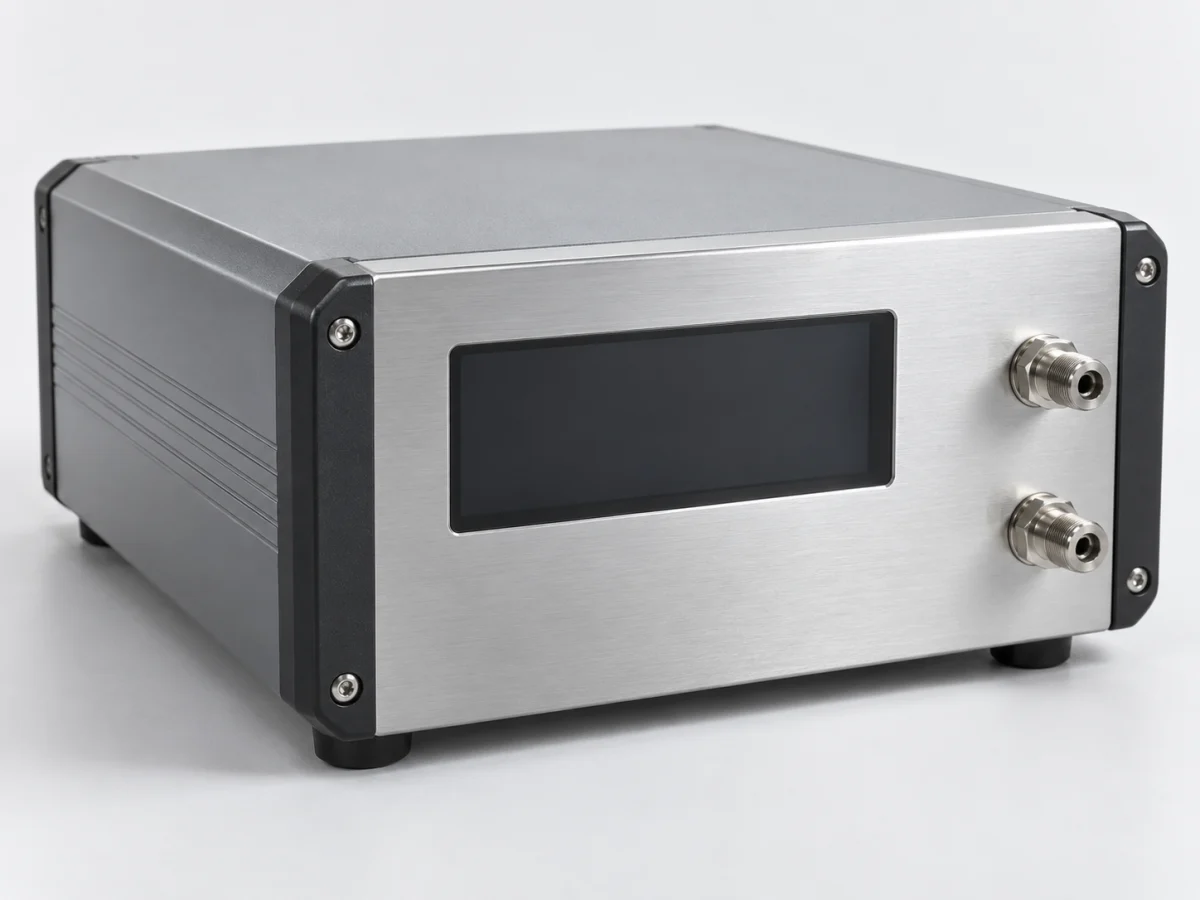
Finished industrial nitrogen purity analyser with an enclosed housing, display window and sample connections
Illustrative sensor product image.
AimN2 or defined impurities
Critical informationComposition of the gas mixture
ResultMeasurement + recorded assumptions

VOMRO engineering approach

First identify which gas you are looking for and in which mixture.

A sensor having nitrogen in its name does not mean it measures N2 directly and selectively in every environment. The available method depends on whether the background gas is nitrogen, argon, helium or another mixture, and whether the change of interest is at percentage or trace level. Two analysers that connect to the same electronic display may therefore not be interchangeable.

For example, a reduction in residual oxygen may be meaningful in an inerting line. If the total nitrogen purity of delivered gas is required, however, moisture, argon and other impurities must also be considered. Naming the measured quantity separately from the calculated display quantity makes clear what the device verifies.

The complete measurement process

From sensed quantity to usable data

  1. 01Defined gas mixture
  2. 02Suitable analysis or impurity channel
  3. 03Matrix and cross-interference checks
  4. 04Direct measurement or explicit inference

Conceptual diagram. The actual measurement range, error budget and validation plan are defined for the application.

01

Oxygen measurement is not direct nitrogen measurement

Measuring only O2 and subtracting the result from 100 assumes that all remaining gas is nitrogen. This is incorrect if argon, CO2, water vapour or other components are present. Atmospheric air also contains more than nitrogen and oxygen. The proportion of non-oxygen gas must therefore not be labelled as nitrogen concentration.

An oxygen-based nitrogen estimate may be used in a verified two-gas process where other constituents are negligible. This is a conditional calculation. The display must state the method and wet- or dry-gas basis, and the calculation must be considered invalid if the mixture changes. A single gas measurement also cannot identify nitrogen as the cause of oxygen depletion in a room.

02

Where are TCD, chromatography and plasma methods used?

A thermal conductivity detector compares a gas's heat-transfer behaviour with a reference. It is not specific to one chemical species; changes in another gas can also affect its output. N2 and O2 values in Emerson's technical guide are close. A simple TCD element should therefore not be treated as a universal sensor that easily distinguishes small nitrogen changes in air.

Gas chromatography separates a mixture into constituents for analysis with a selected detector. It can be appropriate where trace impurities must be separated, but brings requirements such as carrier gas and measurement cycles. Certain plasma-emission analysers are designed for trace N2 in argon or helium. This background requirement does not mean the same device can be used arbitrarily in ambient air.

03

Specify purity targets as an impurity list rather than a single percentage

'Measuring very pure nitrogen' is not enough to select a suitable instrument. Will residual oxygen be checked? Will moisture also be monitored? Do carbon-containing compounds or argon matter? A constituent acceptable at one production stage may cause problems in the next. The supplier's gas certificate and the process quality indicators should be reviewed together.

Document the lowest expected value, normal operating range and possible high exposure separately. Many display digits do not prove adequate sensitivity; zero stability, repeatability and total uncertainty must also suit the target. If purity is calculated from multiple measurements, the report must clearly identify any unmeasured constituents.

04

The sample line is part of the result in trace nitrogen analysis

At very low impurity levels, even a small air leak at a connection can change the result. Regulators, seals, tubing, valves and dead volumes are part of the measurement chain. Line material, cleanliness and leak tightness are evaluated according to the selected analyser's instructions. Transporting the sample unchanged to the analyser is as important as taking it from the correct point.

Sample pressure must be reduced to the instrument's inlet limit, and flow, venting and condensation conditions must be defined. Long lines and inadequately purged volumes can extend response time. Servomex's plasma guide specifically addresses contamination from regulators and lines during calibration. The first prototype test must therefore examine the intended sampling arrangement as well as the circuit board.

05

Plan calibration with the same gas matrix and keep records

The background of the zero gas and known-concentration check gas must suit the analyser's measurement method. A cylinder label alone is not an adequate record: the composition certificate, uncertainty, validity period, regulator and application conditions must be considered together. Adjustment in a different matrix does not guarantee the same result in the actual process.

Checking calibration and changing instrument coefficients are different operations. Record the existing deviation first; if needed, adjust using an authorised method and check again. Acceptance tests include repeated measurements, expected gas changes, line delay and connection loss. Maintenance frequency follows the application and manufacturer instructions; one schedule does not suit every nitrogen analyser.

06

Turn analyser output into reliable device data

A custom board can read a suitable analyser's analogue or digital output, display it and transfer it to process records. Scale, unit, measurement range and the meaning of fault states are defined together according to the protocol. Range information must also be captured when an analyser changes range, since the same output value may represent different concentrations.

Software distinguishes valid measurements, warm-up, calibration, low flow and communication loss. It prevents the last valid reading from appearing current indefinitely. VOMRO's development scope specifies source code, circuit and connection documents as deliverables. Sensor integration does not automatically provide life-safety or explosive-atmosphere suitability for the complete device; assessment for such use is defined separately.

07

Initial information for a nitrogen measurement project

For the initial discussion, share the sample source, all expected gases, the constituent to measure and the change needed to support a decision. 'Monitoring N2 impurities in an argon line' and 'Monitoring residual O2 in a nitrogen generator' are different starting points. An existing analyser model, gas composition certificate and connection diagram are also useful.

Include pressure, temperature, humidity, sample line length, measurement frequency and logging requirements. The quotation clearly assigns responsibility for analyser selection, sample conditioning, electronics, display and field validation. This establishes results verifiable under known conditions and a deliverables list, instead of unnecessary measurement claims.

Measurement approaches for different nitrogen-related requirements
RequirementApproachLimitation
Residual O2 in a nitrogen lineO2 analyser with a suitable rangeDoes not alone establish total N2 purity
Trace N2 in argon or heliumPlasma analyser suited to the matrixThe specified background gas must be maintained
Individual constituents in a mixtureChromatography with a suitable column and detectorRequires a measurement cycle, carrier gas and maintenance
Changes in a defined binary mixtureTCD with verified suitabilitySimilar conductivities and third gases are limitations

How it works

A clear process from start to delivery.

Not every project looks the same; however, the measurable requirement, controlled revision, and field verification steps remain unchanged.

  1. 01

    Describe the composition

    Document the main gas, impurities, moisture basis and measurement target.

  2. 02

    Verify the method

    Check the analyser's suitability for the gas matrix and required uncertainty.

  3. 03

    Test the line and board

    Test sample transport, electronic reading and fault states together.

  4. 04

    Record acceptance

    Define check gases, test conditions and delivery documents.

Frequently asked questions

Before starting the project

The technical scope, deliverables and test plan are clarified together according to the requirements of your project.

Are azot and nitrogen different gases?

No. Azot and nitrogen on this page refer to molecular N2 gas. Nitrogen dioxide NO2, ammonia and other nitrogen compounds are different target gases requiring separate measurement methods.

Can I calculate nitrogen percentage from an oxygen sensor?

A conditional estimate is possible only under composition conditions confirming that the remaining gas is nitrogen. If argon, moisture, CO2 or other gases are present, O2 measurement alone does not determine nitrogen percentage.

Can an NDIR module for CO2 also measure nitrogen?

No. An ordinary CO2 NDIR module cannot be converted to N2 measurement. Select a method specified for nitrogen analysis that suits the target gas's measurement physics and the gas mixture.

Does TCD distinguish every gas from every other gas?

No. It responds to a bulk physical property and cannot identify every constituent of a mixture by itself. The similar thermal conductivities of nitrogen and oxygen are a particular limitation in distinguishing them.

Why must water vapour be specified in nitrogen analysis?

Moisture can affect composition and the method used. Dry- and wet-gas ratios are not directly comparable; if drying is used, record how the sample changes and the basis of the result.

Can you make a custom display and logging board for my existing analyser?

Technical suitability is assessed if the output protocol and rights to use it are available. A board, display and logging software can be included in the project scope, accounting for scaling, fault and calibration states.

Your project, your product

Developed confidentially and delivered with source files.

We may work with a confidentiality agreement (NDA) before sharing technical details. At the end of the project, we deliver the source codes, design files and technical documents we have developed to you.

  • NDA before sharing technical information
  • Clear deliverables agreed at the outset
  • Source and technical files at the end of the project
Our confidentiality and delivery process
Let's start with your idea

Share your gas composition and measurement target

Describe the constituent to measure, expected range and existing analyser; together, we can define the custom electronics and logging scope.