
Selectivity, maintenance and validation for CO

Carbon monoxide sensors: assess CO measurement as part of the complete device

Carbon monoxide CO measurement requires a gas cell, analogue electronics, sample inlet, software and maintenance arrangements to work together. A data acquisition prototype and a life-safety alarm device require different validation scopes. VOMRO clarifies intended use and measurement conditions at the outset of custom CO sensor projects, then develops electronics and software within that scope.

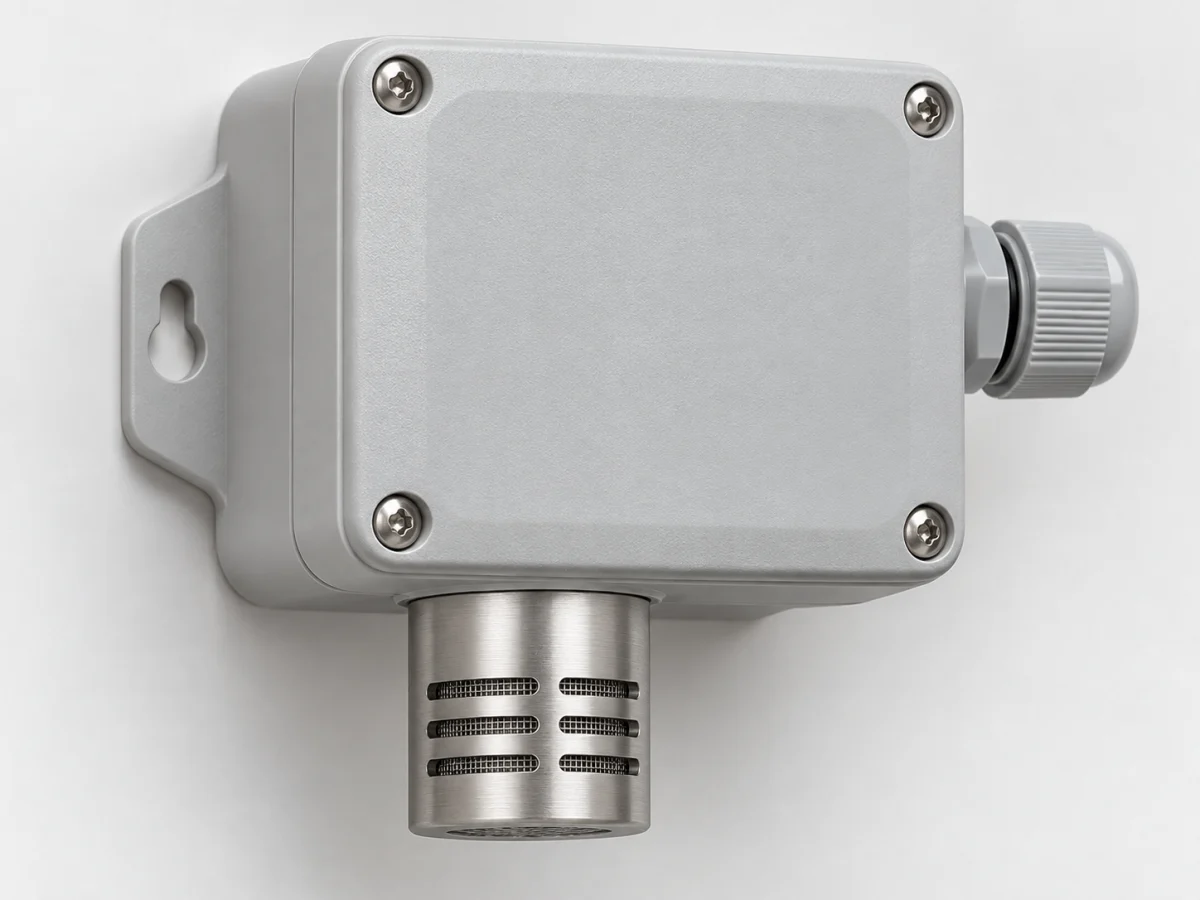
Finished CO sensor with an enclosed housing, cable entry and gas diffusion head
Illustrative sensor product image.
GasCarbon monoxide, CO
Example interferenceHydrogen and some organic gases
DevelopmentSensor + electronics + testing

VOMRO engineering approach

Define CO measurement separately from the device's intended-use claims.

Carbon monoxide CO and carbon dioxide CO2 are different gases. A CO2 module used for ventilation does not replace CO measurement. Two channels may share an enclosure, but each must have its own sensor, scale, check gas and validation.

Recording relative changes in production testing, examining a combustion process and collecting ambient data are different objectives. They alter measurement range and selectivity requirements. Using a ready-made sensor also does not automatically validate the finished product's alarm behaviour, fault detection or suitability for a particular use.

The complete measurement process

From sensed quantity to usable data

  1. 01Defined sampling point
  2. 02CO-sensitive cell
  3. 03Front end and cross-interference control
  4. 04CO value and maintenance information

Conceptual diagram. The actual measurement range, error budget and validation plan are defined for the application.

01

How is an electrochemical CO sensor read?

In an electrochemical CO cell, the gas reaction at the electrode produces a small current. The front end maintains the electrode conditions required by the selected cell, then converts the current to voltage for digitisation. CO concentration is calculated using zero and sensitivity coefficients. Pin count or physical dimensions alone do not determine the appropriate circuit.

Some models are designed for a stable baseline at lower levels, others for higher CO ranges or different interference conditions. Follow the manufacturer's circuit recommendations rather than connecting the cell directly to a general-purpose analogue input. With a ready-made module, also examine its internal calibration scope, communication details, new-data rate and error codes.

02

Hydrogen and other gases can produce incorrect CO results

A CO sensor's response to other gases depends on the model. Hydrogen is a selection criterion, particularly where it is known to be present. Honeywell TN-121 shows that certain CO cells respond to hydrogen and some organic gases. Its numerical values are not fixed ratios applicable to every CO sensor.

A cell developed for low hydrogen sensitivity or a suitable multichannel arrangement may be considered. A carbon filter does not eliminate all interference; it reduces particular gases, and its capacity can change in use. Project testing uses the expected gas mixture. If another channel supplies a numerical correction, validate the method under actual conditions rather than simply subtracting two measurements.

03

Range, gas overexposure and service life are different characteristics

Define the lowest normal level, highest level and brief high exposure separately. High-gain electronics selected for low-level monitoring may saturate at high gas concentrations. An output reaching its upper limit does not mean the actual concentration equals that value; it must be flagged as overrange.

Electrochemical cell and filter performance can change with time and exposure. SGX notes that high or prolonged gas exposure may affect zero and sensitivity. Record operating conditions and check results as well as the purchase date. Do not assume old calibration coefficients remain valid automatically after fitting a new cell.

04

Membranes, pumps and temperature affect response speed

The cover, membrane and filter in front of a gas cell affect device response time. Protection from dust or liquid can slow gas passage excessively. In pumped sampling, inlet pressure and pulsation are also evaluated. An exposed sensor's response time may not remain unchanged after enclosure installation.

Hot gas entering a cold assembly can cause condensation; temperature changes can also affect zero and sensitivity. For process CO measurements, prepare suitable sample conditions rather than feeding gas directly into a room-type module. Test tubing, filters and flow arrangements with the finished product. Incorporate the manufacturer's humidity, pressure and gas-matrix limits into the device design.

05

Functional checks and calibration are different operations

Seeing a response to a known gas does not establish acceptable measurement accuracy across the full range. Functional checks, calibration checks and coefficient adjustments are planned for different purposes. With zero conditions and a known CO mixture, record deviation first and then adjust according to instructions if required.

Test records include check-gas composition, flow, application fixture, waiting time and environmental conditions. The entire sample path is tested from the actual inlet. Instead of assigning every CO project the same maintenance interval, consider manufacturer recommendations, exposure and required performance. Gas trials use appropriate equipment and competent personnel; improvised gas generation by combustion is not a verifiable test method.

06

Electronics and software must distinguish faults from measurements

For the low-current front end, assess input leakage, reference stability, gain and output headroom before saturation. SGX's electronics application note explains the importance of sensor-specific electrode voltage and current-to-voltage conversion. The cell's return to stable measurement after power is removed and restored is also tested.

Software distinguishes startup, stable measurement, calibration, overrange and communication loss. Long averaging can delay real changes, so filtering is selected for the application. If a control or warning output is required, behaviour during sensor, power and processor faults is separately defined. A certified life-safety function requires broader product assessment than an electronics prototype.

07

Your starting information for a CO measurement device

Document the device's purpose, location and expected CO levels. Identify possible hydrogen, solvent vapours or other interfering gases. Ambient temperature and humidity, gas pressure, sampling method, measurement frequency and maintenance access are needed for selection. Include the exact code of any existing module or cell.

VOMRO can define the board, software, display, logging and enclosure scope together. Check gas and reference availability, testing responsibilities and acceptance conditions form part of the quotation. Project source files, connection documents and test records are listed as deliverables. This produces a device whose verified functions and conditions are clear.

Options to compare in a CO project
OptionSuitable starting pointConsideration
Standard electrochemical cellDefined CO measurement rangeInterfering gases and front-end circuitry
Cell with low H2 interferenceMixture that may contain hydrogenChecking residual interference under actual conditions
CO module with integrated electronicsFaster prototyping and digital outputCalibration, range and data validity
High-range process arrangementDefined sample containing high CO levelsSample conditions, saturation and recovery

How it works

A clear process from start to delivery.

Not every project looks the same; however, the measurable requirement, controlled revision, and field verification steps remain unchanged.

  1. 01

    Determine the intended use

    Describe data acquisition, process control and the required product functions.

  2. 02

    Examine the mixture

    Document hydrogen and other interfering gases alongside the CO range.

  3. 03

    Validate the measurement

    Evaluate the final sample path, board and software using known gases.

  4. 04

    Document maintenance

    Define records for functional checks, calibration and cell replacement.

Frequently asked questions

Before starting the project

The technical scope, deliverables and test plan are clarified together according to the requirements of your project.

Are CO and CO2 sensors interchangeable?

No. They concern different gases and measurement principles. A CO2 sensor does not provide carbon monoxide results; if both gases are required, plan separate suitable channels.

Can hydrogen affect a CO sensor?

Yes, it can interfere with many cells. The extent depends on the model and conditions. A project involving hydrogen should consider a low-interference option and testing with the actual mixture.

Does a carbon filter block all interfering gases?

No. A filter is effective for particular gases; capacity and usage history matter. It is not a universal solution for other gases or sensor ageing.

Does a changing reading after gas exposure count as calibration?

Not by itself. A response gives information about function. Concentration accuracy requires comparison using known gas, defined conditions and acceptance criteria.

Does buying a bare CO sensor mean I have made a certified alarm?

No. A sensor component's characteristics do not establish the complete device's performance or conformity. Alarm function, fault behaviour and the product assessment required for its intended use must be addressed separately.

Do software settings change when a new CO cell is fitted?

Since zero and sensitivity can vary between cells, replacement is followed by checks and any necessary adjustment according to the manufacturer's method. Old coefficients are not assumed to remain correct.

Your project, your product

Developed confidentially and delivered with source files.

We may work with a confidentiality agreement (NDA) before sharing technical details. At the end of the project, we deliver the source codes, design files and technical documents we have developed to you.

  • NDA before sharing technical information
  • Clear deliverables agreed at the outset
  • Source and technical files at the end of the project
Our confidentiality and delivery process
Let's start with your idea

Describe your CO measurement target and gas mixture

Share the location, range and logging or control needs; together, we can define the sensor board and test scope.