
From experimental process to manufacturable device

Custom product development for laboratory and analytical instruments

You may want to turn a research setup into a repeatable instrument or develop a laboratory product under your brand. VOMRO designs the circuit board, operating software, user display and mechanics together. For heating, mixing, dosing, sample preparation and sensor-based measurement, we first define the process, then plan prototyping and validation.

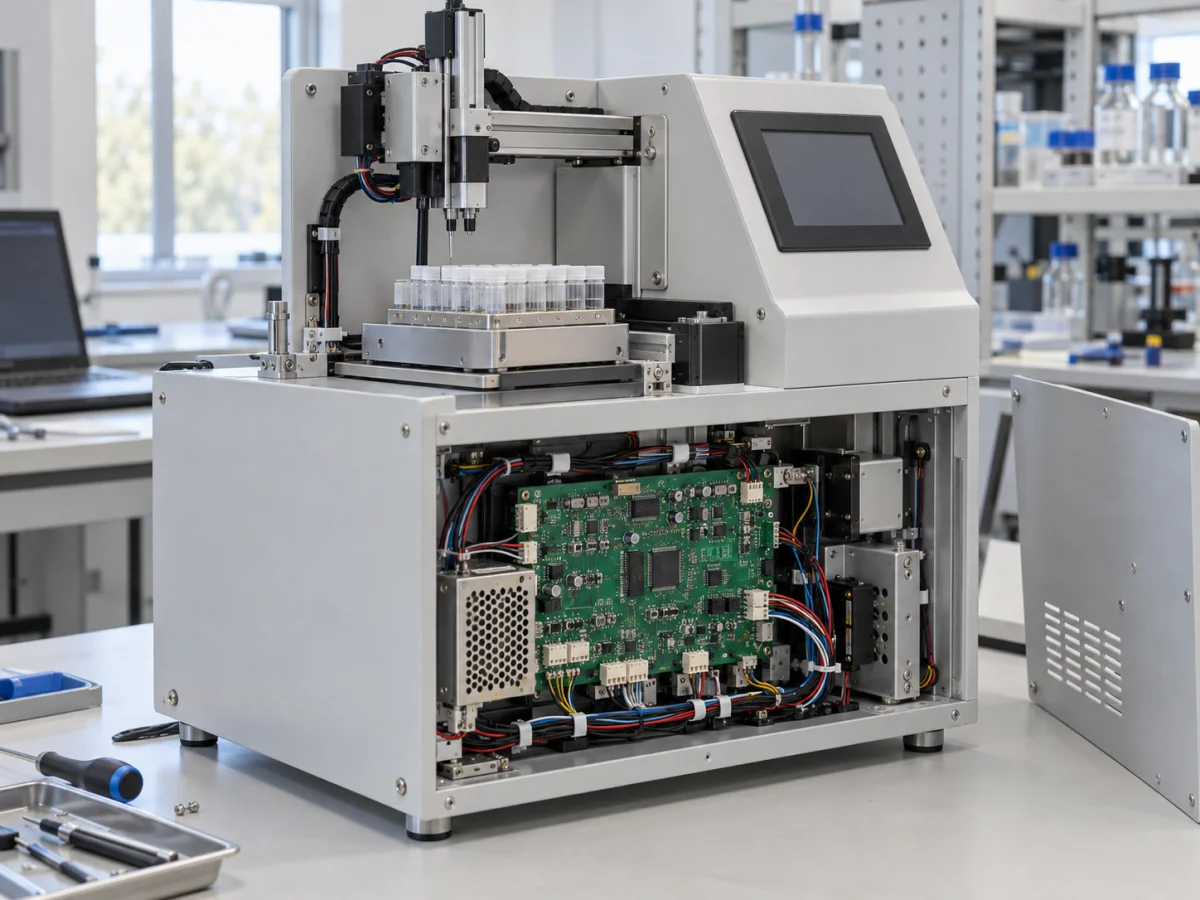
Custom control board, sensor connections and sample compartment in the open enclosure of a laboratory device with a display
Representative application image.
AimInstrument manufacturers and research products
ScopeMeasurement, control, software and mechanics
OutputA prototype and project package with source files

Your project, your product

Developed confidentially and delivered with source files.

We may work with a confidentiality agreement (NDA) before sharing technical details. At the end of the project, we deliver the source codes, design files and technical documents we have developed to you.

  • NDA before sharing technical information
  • Clear deliverables agreed at the outset
  • Source and technical files at the end of the project
Our confidentiality and delivery process

VOMRO engineering approach

We first determine how to repeat the process, then how to build the instrument.

A procedure performed manually by one researcher and a commercial instrument used by different people have different requirements. Sample loading, operation order, waiting time and recording results affect the entire product. Laboratory instrument design begins with that workflow. We distinguish variables to control from results that will only be observed.

Projects may involve developing a new analytical instrument, adding control electronics to an existing instrument family or commercialising an experimental setup. We aim for a design whose steps operators can repeat consistently and manufacturers can reproduce. This page focuses on developing products for laboratory use. Factory test fixtures used to assess other products are a separate application.

01

Starting laboratory instrument design: sample, process and use

In the first discussion, describe the instrument's task through everyday use. Is the sample liquid or solid, how many samples are processed at once and when does the operator intervene? Working volume, temperature range, duration and cycle count establish design boundaries. If an experimental method or working setup exists, its measurements and observed problems are valuable inputs.

A research prototype may prioritise access to frequently changing settings. A commercial product may instead prioritise clear operation, cleanable surfaces, controlled settings and service access. These expectations form the requirements list, which also defines acceptance measurements. Time to target temperature, dosing repeatability and complete record creation, for example, are evaluated separately.
02

Custom control electronics for heating, mixing and dosing

Heater power, sensor position and the sample's thermal response are assessed together. Displaying a target temperature is insufficient; the heating curve, variation around target and response to changed loads must be observed. For mixing, motor choice, speed range, transmission and vessel properties influence electronic control. Testing different sample volumes is therefore valuable.

Dosing and fluid transfer depend on the pump, tubing, valves and fluid properties together. Running a motor for a fixed duration does not deliver the same volume under every condition. Where appropriate, weighing, flow or other feedback can monitor the result. The method follows target quantities, repeatability and maintenance needs. Control-board outputs and stopping behaviour are validated with real loads.

03

Sensor-based measurement and optical detection where appropriate

Measurement electronics can be developed for temperature, pressure, weight, conductivity or another suitable quantity. A sensor's specified resolution alone does not describe completed-instrument performance. Cable length, power, environmental influences, mounting and software filtering also contribute. The required range and uncertainty target are discussed upfront, with a reference method defined for prototype comparison.

Optical measurement projects assess the light source, detector, optical path and sample-vessel positioning together. Ambient light, contamination and changes in sample position can affect readings. Obtaining a measurable signal in preliminary work, converting it into the intended analytical result and validating it with different samples are separate stages. Application-specific performance is established through measurements at these stages.

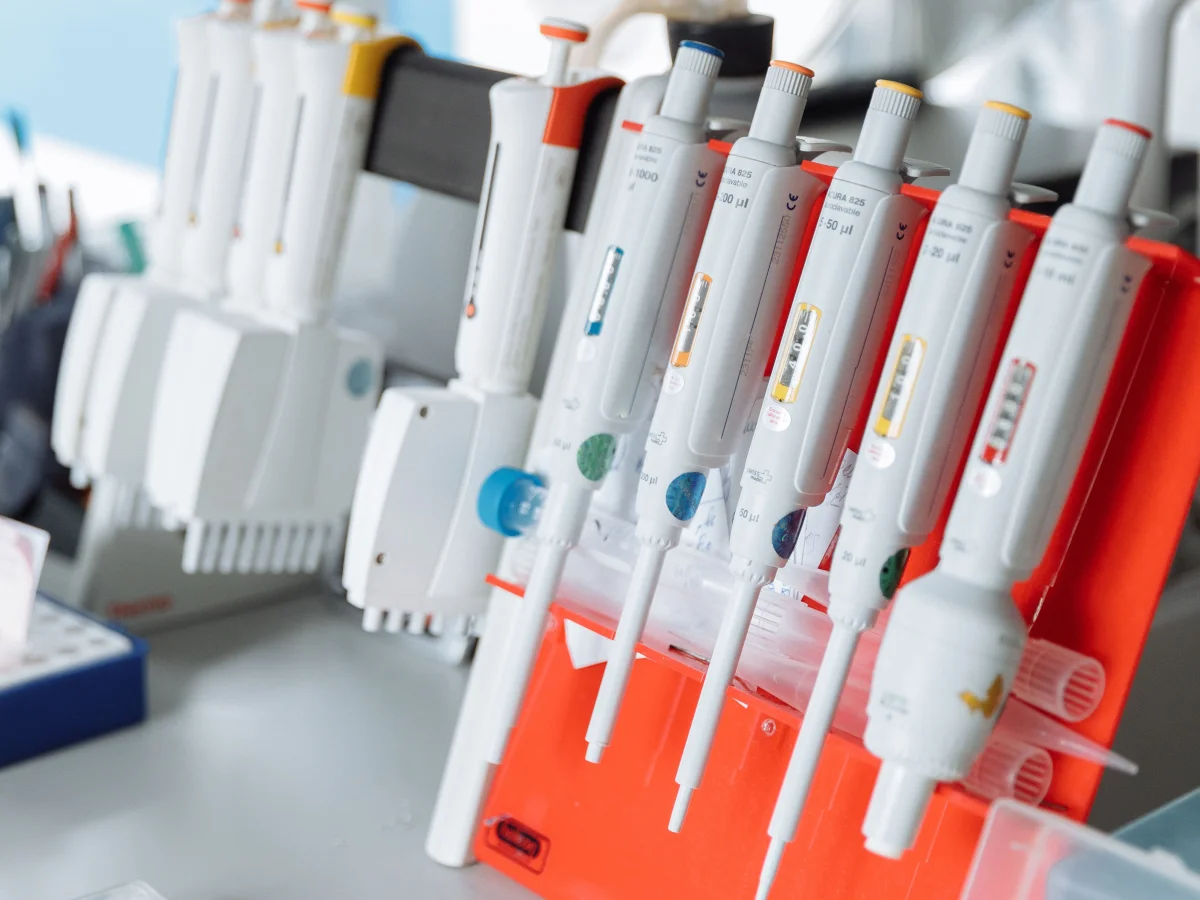
Pipettes arranged on stands on a laboratory bench
Pipettes used in a laboratory.
04

Sample preparation mechanisms, mechanical design and enclosures

Securing a sample and returning it to the same position matter as much as measurement itself. Projects requiring holders, lids, moving stages or fluid lines develop mechanics alongside electronics. Gloves, one-handed vessel removal and draining residual fluid after a process are considered in the initial layout. Materials and cleaning methods for sample-contact parts are evaluated separately.

The enclosure supports the display while also providing thermal management, wiring organisation and service access. The sensitive measurement section's position relative to motors and power circuits is considered at this stage. Initial layouts may use 3D printing or other suitable prototyping. Subsequent manufacturing methods follow quantities and product maturity; usability is tested before committing to expensive tooling while scope remains uncertain.

05

User displays, process recipes and traceable records

Screen flows define what the operator sees when starting a process. Sample information, current step, remaining time and required intervention can be displayed clearly. Common temperature, speed and duration settings can be stored as recipes. Define editing permissions, allowable ranges and effects on a running process. Users can then follow what the instrument is doing rather than confronting only a technical parameter list.

Records may include device identity, software version, selected recipe and timestamps alongside results. Interrupted processes and sensor faults should be evident. File transfer, computer software or server connectivity requires defined data formats and permissions. Traceability follows actual usage needs; a records screen alone does not establish that every process has been validated.

06

Reference measurements, calibration and acceptance testing

Calibration establishes the relationship between the instrument's reading and a suitable reference. Plan measurement points, environmental conditions and recording methods. If adjustments are applied, define that separate step and the coefficients to preserve. Rapid production functional checks and measurement-performance assessments have different purposes, and their outputs are stored without confusing them.

The test plan extends beyond normal cycles. Sensor disconnection, lid or sample-state changes, power loss and restarting are also assessed. Report the conditions under which specified functions were validated. Additional tests and authorised assessments required by intended use are discussed upfront. A research prototype and a product intended for sale therefore have different validation scopes.

07

From the first prototype to a reproducible laboratory product

The first prototype tests critical assumptions through measurement. A measurement or motion subsystem can precede the integrated instrument where necessary. Board, embedded software and mechanical revisions are linked in the same records, making it possible to trace which version resolved a usability finding. As the product develops, component availability, assembly steps and replaceable parts are also assessed.

Repeat production can include a BOM, programming method, device settings and functional-check instructions. Development budgets and unit manufacturing costs are considered separately. PCB fabrication and assembly support are offered only within customer projects developed by VOMRO. After pilot results, manufacturing methods and testing are reviewed to establish the production plan.

08

Confidentiality, project sources and technical continuity

An NDA can protect your research method, product idea or sample information before technical sharing. We address that request at the outset. Responsibilities, customer-supplied methods and references, development scope and deliverables are documented. You do not need a finished technical solution; describe the process and how you will judge success to begin.

Project schematics, PCB designs, embedded software sources, mechanical CAD and technical documents are delivered at completion. Sources for computer or server software within scope also appear in the delivery list. Build, programming, configuration and testing information is organised to support later development. Third-party component licences are stated separately.

Starting a laboratory instrument project from the requirements
RequirementDevelopment focusInitial assessment input
Turning an experimental setup into a productProcess sequence and integrated instrumentMethod, sample and existing measurements
Custom measuring instrumentSensor interface and result recordingMeasurement range and reference method
Sample preparation instrumentMotion, temperature and fluid controlCycle, volume and operating steps
Developing an instrument familyShared board and product optionsModels, target volume and service requirements

How it works

A clear process from start to delivery.

Not every project looks the same; however, the measurable requirement, controlled revision, and field verification steps remain unchanged.

  1. 01

    Let's define the process

    Clarify the sample, method, operator steps and success criteria together.

  2. 02

    Let's test the critical function

    Assess a decisive subsystem, such as measurement, heating or motion, with an appropriate preliminary prototype.

  3. 03

    Let's integrate the instrument

    Combine the board, software and mechanics, then test using reference measurements and operating scenarios.

  4. 04

    Let's prepare the delivery package

    Organise the approved version's sources, manufacturing information and test records.

Frequently asked questions

Before starting the project

The technical scope, deliverables and test plan are clarified together according to the requirements of your project.

Do I need an existing electronics design to develop a laboratory instrument?

No. Describe the process, sample characteristics and intended result. We can review existing setups or measurement records. Once requirements are established, we define electronics, software and mechanical development scope together.

Can you develop only the control board or instrument software?

Yes. A subsystem scope can follow assessment of existing mechanics and technical information. Interfaces to sensors, motors and displays, along with testing responsibilities, are defined upfront.

How are measurement performance and calibration requirements defined?

The measured quantity, working range, conditions and suitable reference method are assessed together. Target performance and acceptance steps are documented. Calibration, adjustment and functional testing are defined as separate tasks.

Can we start with one research prototype and move to production later?

Yes. A critical-function prototype can precede an integrated sample and pilot production. Component choices, mechanical manufacturing and production checks are reviewed as quantities and experimental results become clearer.

Can we work under an NDA and receive source files at completion?

Yes. An NDA can precede technical sharing. Schematics, PCBs, software sources, mechanical CAD and technical documents developed within scope are delivered. The contract clarifies the file list and third-party licence conditions.

Let's start with your idea

Let's talk about the product you dream of and the need you want to solve.