
Measuring water vapour in the right place and at the right temperature

Humidity sensor selection: from relative humidity to device integration

In most ambient applications, a humidity sensor reports water vapour in air as relative humidity. This value depends on temperature; comparing two locations at different temperatures solely by humidity percentage can be misleading. Sensor selection must consider airflow, condensation, chemical exposure and maintenance access as well as operating range. In projects adapting humidity measurement to a customer's electronics, software and enclosure, VOMRO defines measurement conditions at the outset.

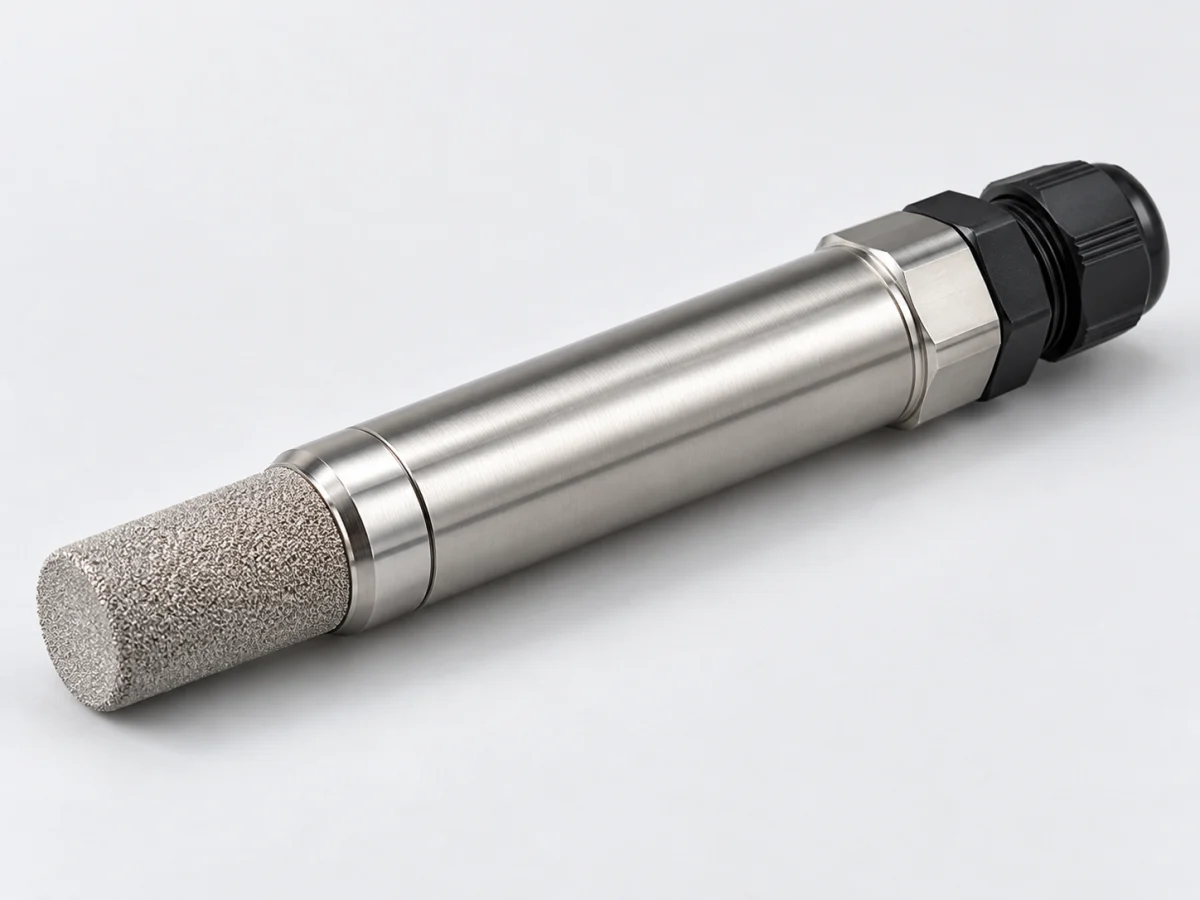
Finished industrial humidity sensor probe with a sintered metal filter tip and sealed body
Illustrative sensor product image.
Common outputRelative humidity: %RH
Combined measurementTemperature and humidity
Design focusAir access, thermal effects and contamination

VOMRO engineering approach

Humidity percentage describes an environmental condition, not an amount of liquid.

Relative humidity is the ratio of the partial pressure of water vapour to its saturation vapour pressure at the same temperature. If air containing the same amount of water vapour changes temperature, its relative humidity can also change. Temperature, humidity and measurement time are therefore recorded together; when comparing two sensors, check whether they experience the same conditions.

Air humidity, soil moisture and a material's water content are different measurement problems. Placing an ambient humidity sensor directly in soil or liquid does not create a suitable method for measuring these quantities. The information required by the application is distinguished during the initial discussion.

The complete measurement process

From sensed quantity to usable data

  1. 01Ambient air
  2. 02Humidity and temperature together
  3. 03Placement and condensation control
  4. 04Relative humidity and a valid record

Conceptual diagram. The actual measurement range, error budget and validation plan are defined for the application.

01

How does a capacitive humidity sensor work?

In a capacitive humidity sensor, the capacitance of a sensitive layer changes as it interacts with water vapour. Measurement electronics process this change; an analogue component may provide a voltage, while a digital component provides processed data. In explaining this principle, Sensirion's design guide emphasises evaluating sensor performance separately from finished-device performance.

Do not select a component solely by the smallest error value in its catalogue. The intended humidity and temperature region, measurement frequency, electrical interface and exposure to ambient air are considered together. When updating an existing product, the old and new sensors' commands, data scaling and error behaviour are also included in the comparison.

02

When do relative humidity and dew point support different decisions?

Dew point is the temperature at which saturation is reached for the current water vapour conditions. A surface falling below that temperature may develop condensation; room relative humidity does not need to reach 100%. NPL defines dew point as the temperature at which condensation begins as a gas is cooled. Monitoring room humidity alone does not always explain the condition of a particular surface.

If the project aims to monitor condensation risk in a refrigerated box or electronic enclosure, surface temperature may also need evaluation. A software-derived dew point is shown as a separate field, and its inputs and calculation method are recorded. This keeps directly measured humidity distinct from the calculated result and allows subsequent analysis to be reproduced.

03

How do the enclosure and PCB affect humidity measurement?

Air reaching the sensor must represent the environment being monitored. Sensirion recommends a small internal volume and suitable air openings, while Bosch recommends separating the sensor from PCB heat sources. A sensor in an enclosed pocket heated by a processor may read a different temperature and relative humidity from the room air.

We therefore do not treat the enclosure as a cover added after the electronics are complete. Air inlets, the sensor compartment, mounting orientation and maintenance access are drawn together in the first prototype. The finished device and reference setup are logged simultaneously to observe response differences. The solution balancing sealing requirements with air access is developed for the operating environment.

04

What should be checked regarding filters, condensation and cleaning?

A protective membrane may be considered to protect the sensor surface while maintaining air access, but not every coating or adhesive is suitable. Bosch's assembly instructions address resin coatings and cleaning materials separately. Instead of applying arbitrary chemicals to the sensitive surface, follow the selected sensor manufacturer's instructions and the mechanical protection approach.

Include dust, oil vapour, cleaning agents, splashes and repeated condensation in the application description. These conditions do not all require the same protection. If a replaceable filter is planned, define the service interval, measures to prevent incorrect installation and the comparison method after replacement. Recheck measurement delay and field behaviour when protection is added.

05

How is humidity data transferred to the control system?

A local digital sensor's interface does not directly determine the cabling of an entire facility. Measurements may use a short connection inside the device, with a separate electronics layer designed for transfer to the main system. Communication is selected according to field distance, existing controller, update requirements and maintenance practices. The unit and scale of each data packet are clearly defined.

We recommend storing temperature, timestamps, validity and any correction version with humidity records. After a connection loss, the last value must not appear as a new measurement. In dehumidification or ventilation control, on/off decisions and waiting periods are tested for the application; measurements, control outputs and user notifications should be separately traceable.

06

How should comparison and calibration be performed?

Different readings from two devices in different locations do not directly establish a sensor fault. First evaluate airflow, temperature, stabilisation time and reference position. Sensirion discusses representative placement and system accuracy separately. Applying a fixed correction without recording comparison conditions risks concealing a placement error through calibration.

For project validation, we select multiple conditions representative of the operating region. Logging during rising and falling humidity, opening the enclosure, power cycling and changing protective parts may be included in the test plan. If a calibration service is required, the reference setup, uncertainty and reporting scope are defined separately. Delivery documents explain what the production test verifies on each device.

07

How should a project brief be prepared for different applications?

Storage monitoring, internal device environmental logging, greenhouse automation and drying control share the same starting question: which decision will the measurement support? Monitoring regional trends in a warehouse and controlling the airflow path inside a device may require different numbers of measurement points. Comparing locations in the first prototype helps avoid both unnecessary sensors and a single unrepresentative point.

For a VOMRO review, send the humidity and temperature region, environmental photographs, chemical exposure, power supply, data interface and required logging duration. Together with target quantities, service arrangements and deliverable files, these allow us to define the measurement board, embedded software and enclosure scope. After successful laboratory trials, a logged pilot study is planned at the actual installation.

  • Distinguish air humidity from material moisture.
  • Record temperature and humidity together.
  • Recheck response when a protective component changes.
Information that should be distinguished in a humidity project
InformationWhat does it describe?Use in design
Relative humidityTemperature-dependent water vapour ratioEnvironmental logging and control input
TemperatureThermal conditions at the sensor locationSupports humidity interpretation and comparison
Dew pointSaturation temperature; can be measured directly or calculatedState the method; evaluate alongside surface temperature
Material moistureWater content of a materialRequires a separate sensing method

How it works

A clear process from start to delivery.

Not every project looks the same; however, the measurable requirement, controlled revision, and field verification steps remain unchanged.

  1. 01

    Describe the environment

    We define humidity, temperature, condensation and chemical exposure conditions.

  2. 02

    Design the airflow path

    We evaluate the sensor, housing openings and protection in the same prototype.

  3. 03

    Integrate the data

    We develop measurement, status, logging and control interfaces.

  4. 04

    Compare in the field

    We record stable conditions and transitions using a reference setup.

Frequently asked questions

Before starting the project

The technical scope, deliverables and test plan are clarified together according to the requirements of your project.

Why does humidity percentage change when moisture content stays the same?

Relative humidity depends on temperature. Even with the same amount of water vapour, temperature changes can produce different percentage readings; the temperature record must also be examined.

Can condensation occur below 100% humidity?

Yes. A surface cooler than the surrounding air may develop condensation if it falls below the dew point. The room sensor's reading is interpreted alongside surface temperature.

Can I put the sensor in a fully sealed enclosure?

Representative air access is needed to measure the intended external environment. If the aim is to measure inside the enclosure, that is defined as a separate measurement point.

Does a filter slow down the measurement?

Protection and airflow can change the system response. A comparison using the selected filter and enclosure is more meaningful than the response time specified for an exposed sensor.

Can an ambient sensor measure soil moisture?

Ambient relative humidity and soil water content are different quantities. A different measurement method suited to the soil or material is evaluated.

Can you connect existing humidity data to a Modbus system?

Measurement, data mapping and communication electronics can be developed after reviewing the existing sensor and controller's technical information. Fault states are also included in the integration.

Your project, your product

Developed confidentially and delivered with source files.

We may work with a confidentiality agreement (NDA) before sharing technical details. At the end of the project, we deliver the source codes, design files and technical documents we have developed to you.

  • NDA before sharing technical information
  • Clear deliverables agreed at the outset
  • Source and technical files at the end of the project
Our confidentiality and delivery process
Let's start with your idea

Let us adapt humidity measurement to your device's actual environment.

Share the airflow path, humidity and temperature range, exposure and logging needs; we can define the measurement electronics and enclosure scope.