
Custom engineering for yacht, boat and ship projects

Custom circuit boards, PCB design and software for marine applications

You may want to display your boat's tank levels on one screen, record engine-room data or develop a marine device under your own brand. VOMRO provides custom circuit and PCB design, embedded software, mechanical enclosures, prototypes and testing for customer projects intended for yachts, boats and commercial vessels. We consider the control board, interfaces and user interface together, turning your idea into an engineering project that can be prepared for production.

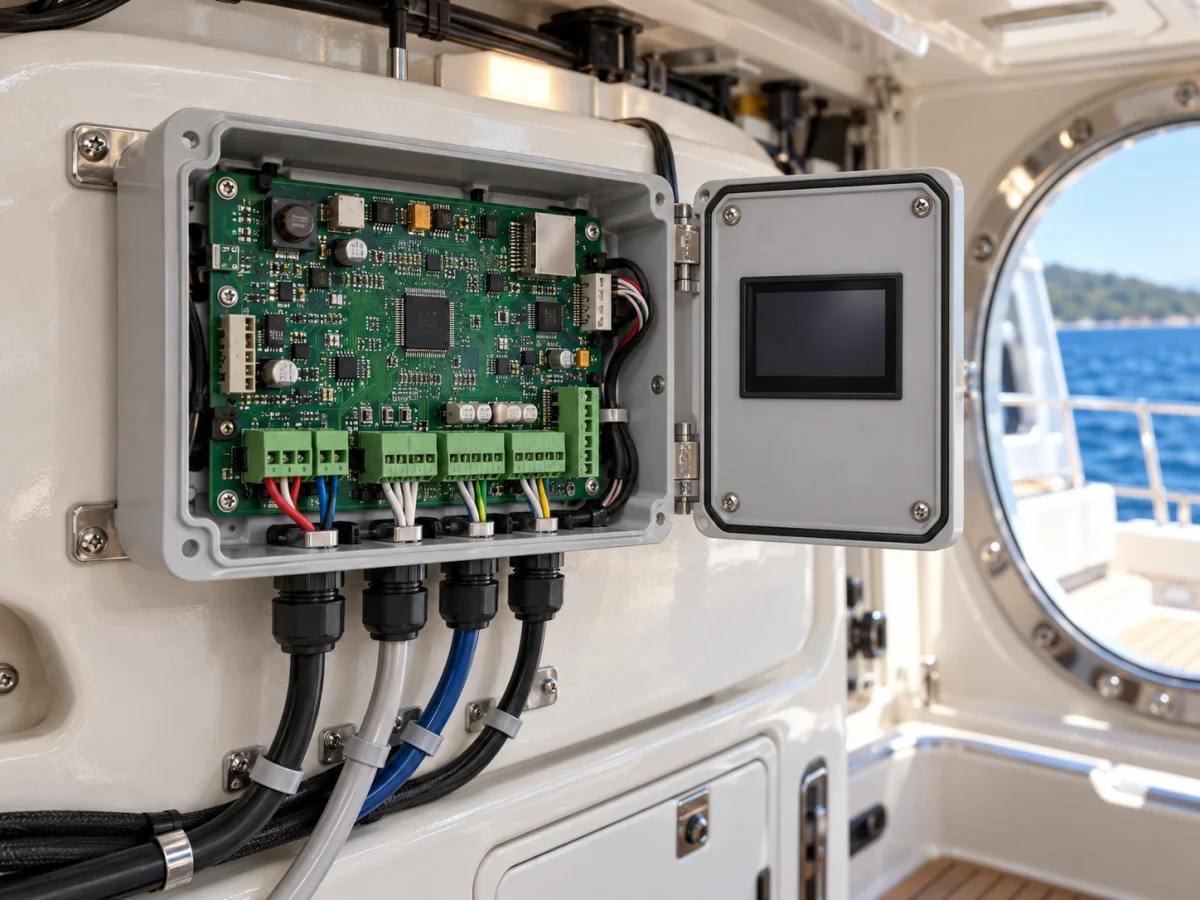
Open enclosure with connection terminals and custom electronic board in the service compartment of the yacht
Representative application image.
ApplicationYachts, boats and commercial vessels
DevelopmentElectronics, software and mechanics
DeliverySource code and design files

Your project, your product

Developed confidentially and delivered with source files.

We may work with a confidentiality agreement (NDA) before sharing technical details. At the end of the project, we deliver the source codes, design files and technical documents we have developed to you.

  • NDA before sharing technical information
  • Clear deliverables agreed at the outset
  • Source and technical files at the end of the project
Our confidentiality and delivery process

VOMRO engineering approach

In marine projects, the board's tasks follow the vessel's use.

A cabin control module that a yacht builder wants to standardise is not designed in the same way as a measurement device added to an operating vessel. In a new build, wiring and mounting can be planned together; in a retrofit, existing panel dimensions, sensors and installation may determine the design. A one-vessel solution and an OEM device reproduced across models also have different cost and servicing requirements. We clarify these distinctions in the first discussion.

A PCB is the printed circuit board on which electronic components are mounted. Custom PCB design involves more than putting a circuit inside an available enclosure: inputs, outputs, power, software and mechanical connections are developed for the application. Vessel type, mounting area, required data and expected production volume are our starting inputs. Design decisions are planned alongside measurable prototype results and the files to be delivered at completion.

01

Custom control boards for yacht builders and marine equipment companies

Custom board architectures can be developed for yacht and boat builders, outfitters and marine equipment companies. Applications may include showing several auxiliary functions on one display, connecting different sensors to a common module or upgrading an existing product's electronics. In OEM work, the device is developed for your product and brand; model options, board revisions and production settings are defined from the outset.

For example, using the same basic board in different vessel sizes requires joint assessment of I/O counts, cable connections and software options. Identifying common and variable parts instead of designing a separate circuit for every model can simplify maintenance and supply. The first prototype is quoted against target volumes and service expectations, separating development fees from board, assembly and testing costs in repeat production.
02

Bilge alarms, tank levels and auxiliary monitoring modules

Auxiliary electronics can monitor bilge compartment levels, pump activation counts and operating time. An energised pump does not prove that water is being discharged; level, operating status and suitable flow measurement where needed are assessed separately. Additional indication, event logging and notifications are planned around an architecture that retains the existing independent pump and float-switch circuit. The notification display should clearly identify the compartment and reason for an alert.

For fresh-water, waste-water or suitable fuel-tank applications, the sensor's electrical output, fluid compatibility and tank geometry matter. Level height does not vary proportionally with volume in every tank. Calibration points are defined for the vessel and tank, while filtering and alarm delays are tested for the effects of rolling and fluid movement. A disconnected sensor must generate a fault indication rather than be displayed as an empty tank.

03

Battery, energy and load records in 12 V and 24 V systems

A device can record service-battery voltage, current measured through an appropriate circuit and auxiliary load operating times. The aim is to show when equipment operates, consumption trends and measurement changes during charging. Battery chemistry, the existing charger, measurement range and wiring are design inputs. A voltage-only display is not assumed to provide an exact state-of-charge percentage under every condition; the required calculation and reference measurement methods are defined separately.

A nominal 12 V or 24 V supply does not mean that the board operates only at that fixed voltage. Engine starting, charging, switching loads and cable connections can cause variations. Input protection, reverse polarity, voltage drop and restart behaviour are assessed. High-current paths and sensitive measurement circuits are considered together in the layout. The project is not defined as automatically taking over existing battery protection or BMS functions.

04

Data acquisition from engine rooms, refrigerated holds and equipment

Sensor interfaces can record engine-room temperature, humidity, vibration or equipment operating status. Measurement location and the mounting surface affect results; ambient temperature and machine-body temperature, for example, represent different information. Vibration recording requires defined sensor mounting, sampling rate and comparable operating conditions. Showing a trend and diagnosing a specific fault are separate objectives; acceptance is based on measurable functions.

Temperature history and door status can also be recorded for a fishing vessel's refrigerated hold, a yacht refrigerator or similar storage compartment. Sensor placement, range, timestamps and alarm delays follow the operating scenario. Records remain stored locally when connectivity is unavailable. The data interface can let maintenance staff examine not only the latest temperature but also preceding changes and recording gaps when investigating an alert.

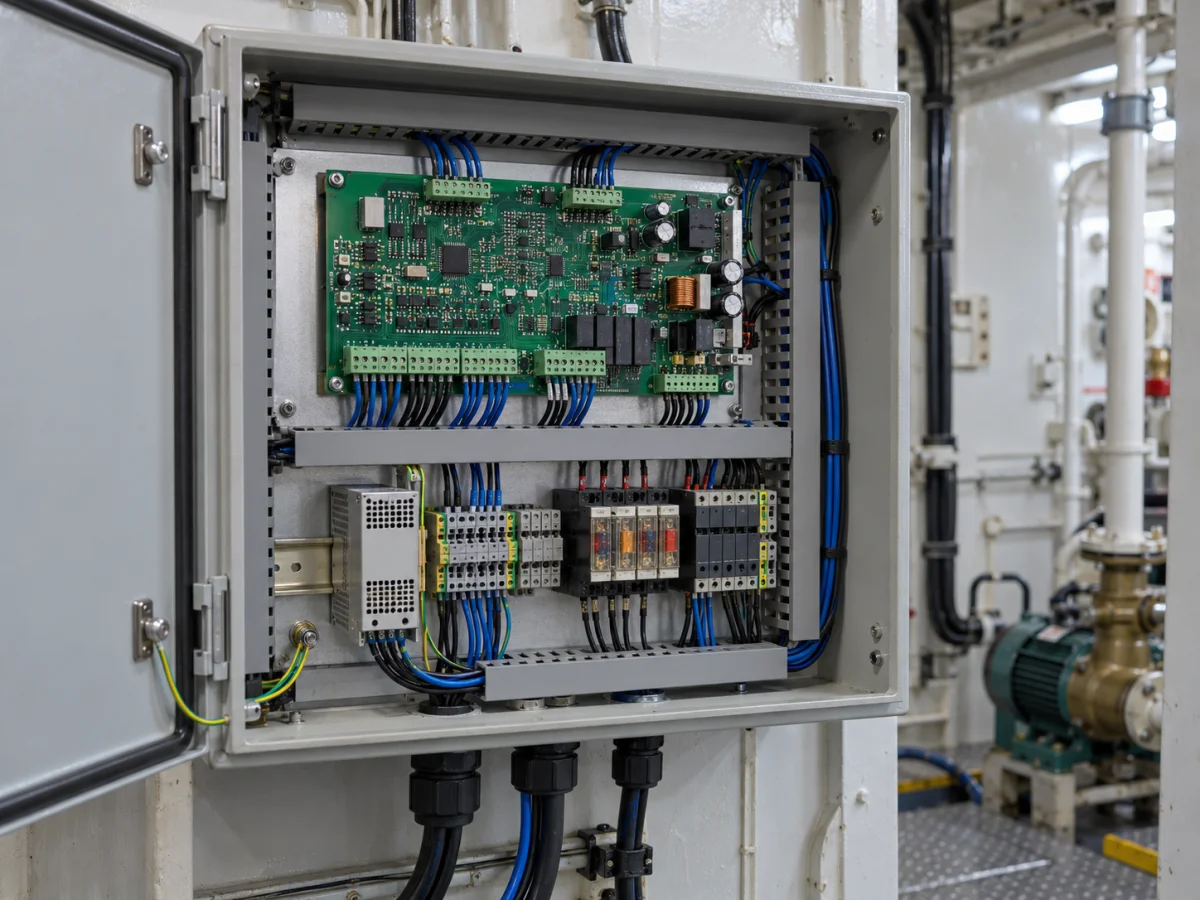
An auxiliary control cabinet with a custom circuit board and sensor connections in a commercial vessel's engine room
Representative application image.
05

Data integration with engines, generators and existing marine equipment

For engine speed, operating hours, temperature or generator status, we first review manufacturer-permitted connections and technical documents. A CAN bus or J1939 interface does not establish that every desired engine parameter is accessible. Brand, model, ECU and available messages must be assessed. Reading data and sending commands require different scopes and tests. Acquiring data without disrupting the existing network is one design objective.

NMEA 2000 is a CAN-based marine communication standard; adding CAN hardware alone does not create a compliant NMEA 2000 product. Integration through a certified gateway can be assessed where appropriate. Direct NMEA 2000 product development requires separate planning for protocol access, licensing, manufacturer and product codes, and certification. For every displayed parameter, define its source, unit, update interval and last valid measurement time; stale data must not appear current.

06

Yacht automation: cabin lighting and auxiliary equipment interfaces

Button panels, displays and control boards can be developed together for cabin lighting, auxiliary fans and defined comfort functions. Initial decisions include which button the user can find in darkness, which status is displayed and how servicing will be performed. Even when marine automation is operated through a single screen, each load's current, startup behaviour and existing protection must be assessed separately.

An LED dimmer and a fan-switching output are not sized in the same way. Output drivers, fuse coordination, cable cross-sections, heating and electromagnetic effects are assessed with the load. Software defines user settings, the state after power restoration and local-control priority. Testing with actual lights and fans is more informative than testing a board only with resistive loads.

07

Local displays, recording and fleet monitoring for vessel automation

The local display or control panel is designed to provide necessary information independently of internet connectivity. Wi-Fi or BLE can support nearby configuration and servicing. Remote transfer over 4G/LTE requires operator coverage at the vessel's location. Instead of assuming uninterrupted cellular service offshore, the design plans local memory, reconnection and transfer of queued records to the server.

Fleet applications may include server software for vessel and device identities, user permissions, event history and maintenance records. Data rules address duplicate uploads, device clock drift and measurements arriving out of chronological order. Displaying an alert locally, delivering it to the server and notifying the relevant person are separate stages. Local and remote notifications are agreed with the customer; service access and software updates also form part of this architecture.

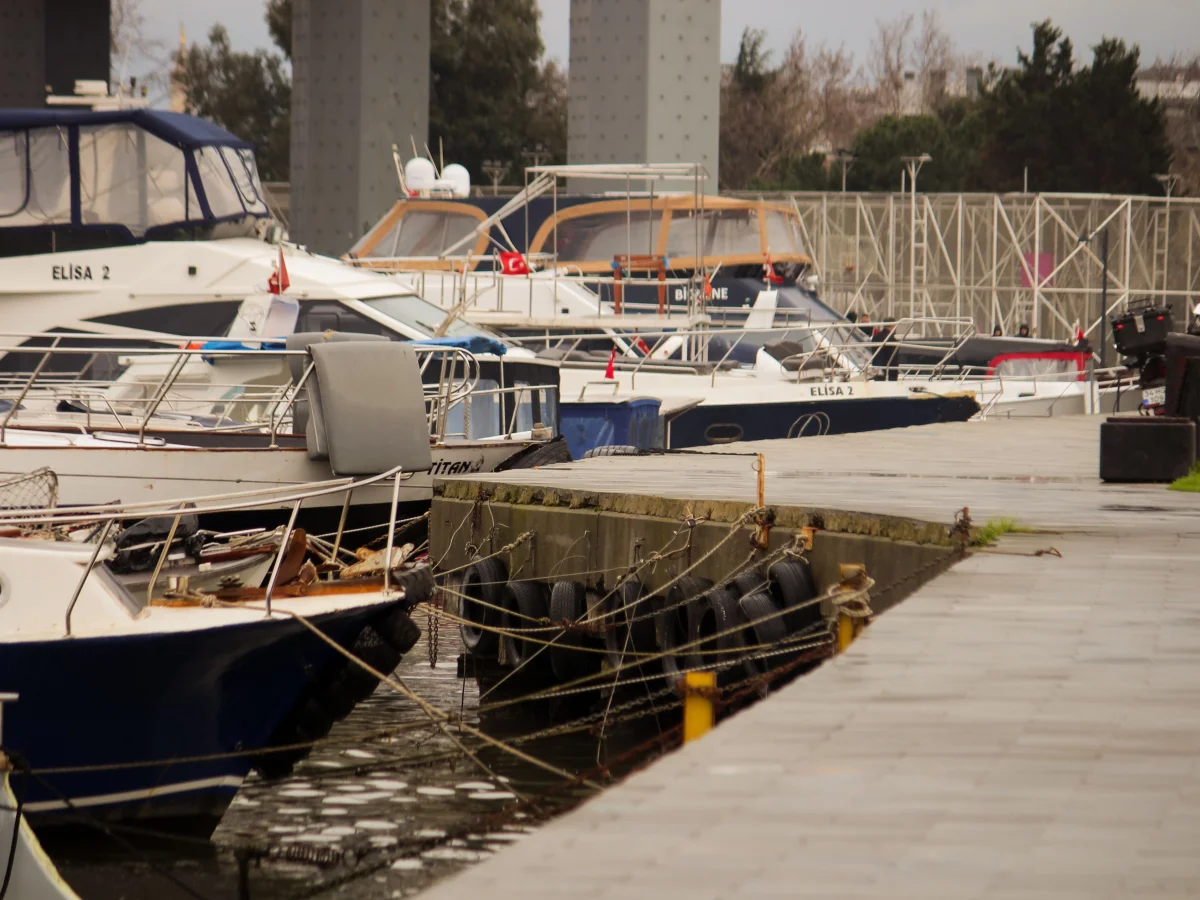
Yachts and boats berthed side by side in a marina
Yacht and boat berths in a marina.
08

Marine PCB development: salt, humidity, vibration and enclosures

A dry cabin compartment, enclosed service space and deck mounting location have different environmental conditions. Expected exposure to splashing, salty humidity, condensation, temperature changes and vibration must be defined. PCB connections, sensitive measurement paths, power components and mounting points are laid out accordingly. If a protective coating is proposed, specify its type, cleaning process, masked areas and later repair method.

The enclosure, gasket, cable entries and connectors form the complete protection system. A coated board does not make a device waterproof. The target IP rating is included in the test scope for the completed enclosure with actual cable connections. Heat removal, condensation risk and service access are also addressed mechanically. EMC assessment represents power cables, displays, communication and connected loads as well as the board.

09

From panel modernisation to prototypes, testing and production preparation

When updating an existing panel's electronics, we first review functions, connection diagrams, available documents and mechanical dimensions. Existing sensors or wiring harnesses may be retained, subject to measured interface compatibility. A mechanical prototype can establish panel cover, display and button positions. Early visibility of assembly and service access helps reduce layout changes after electronics development.

The first board's power, inputs, outputs and communication are tested on the bench, followed by a pilot with target equipment and mounting conditions. Acceptance scenarios include disconnected sensors, power loss, restarts and recording overflow. Hardware and software versions are linked to test records. PCB fabrication and assembly support are provided only for customer projects developed by VOMRO. Repeat production includes the BOM, programming steps, functional testing and revision tracking.

10

NDA, project ownership and source file delivery

At your request, we work under an NDA before you share your product idea, vessel details and commercial plans. Development follows your brand's product plan, operating scenario and delivery expectations. The contract defines electronics, software, mechanical and testing scope and the information each party will provide. You do not need every technical solution in advance; describe the problem and the existing system to begin.

Electronic schematics, PCB design files, source code, mechanical CAD and technical documentation developed within the project are delivered at completion. Manufacturing outputs, the BOM, build and programming instructions, and test records are specified in the delivery list. Third-party protocol software, libraries and manufacturer documents remain subject to their licences. The aim is to provide a usable project package for maintenance, repeat production and future versions alongside the device itself.

Defining marine electronics project scope around the requirements
Project requirementPart to developInformation needed at the outsetOutcome checked at acceptance
New OEM deviceCustom PCB, firmware and enclosureFunctions, target volume and mounting locationDefined functions and repeatable production
Updating an existing panelControl board and user interfaceConnection diagram, dimensions and existing sensorsOperation validated with the installation to be retained
Vessel data acquisitionSensor interface or recording moduleMeasurement list, ranges and data accessValid measurements, timestamps and recovery from interruptions
Fleet monitoringLocal recording, communication and serverCoverage, users and notification flowRecord synchronisation and authorised access

How it works

A clear process from start to delivery.

Not every project looks the same; however, the measurable requirement, controlled revision, and field verification steps remain unchanged.

  1. 01

    Describe your vessel and requirements

    Define the project scope from intended use, mounting location, connections and target volume.

  2. 02

    Let's define the architecture and delivery

    Clarify the board, software, enclosure, integration and testing together in the requirements list.

  3. 03

    Let's assess the prototype together

    Follow bench testing with a pilot using the target equipment, and link results to revisions.

  4. 04

    Let's deliver the manufacturing package

    Deliver the approved design's sources, manufacturing files and technical instructions.

Frequently asked questions

Before starting the project

The technical scope, deliverables and test plan are clarified together according to the requirements of your project.

Do you design boards only for yachts, or also for commercial vessels?

Projects for yachts, boats, fishing vessels and commercial ships can be assessed. Device function and mounting location are decisive. We can define electronics, software and mechanical scope together for a new OEM product, auxiliary monitoring module or existing panel modernisation.

Can we use data from an existing engine or NMEA 2000 network?

We first assess device models, manufacturer-provided data and permitted connections. Integration through a certified gateway can be planned where appropriate. Direct NMEA 2000 product development requires separate consideration of licensing, manufacturer and product codes, and certification. Access to every parameter from every engine is not assumed.

Will measurement and alarms continue without internet access?

Required local functions can be designed to operate independently of connectivity. We define the measurements to retain, memory capacity and local alarm behaviour. Remote notifications and server uploads depend on available connectivity; queued records can be sent after reconnection.

How are testing and approvals defined for marine projects?

Required standards, tests and approval responsibilities are defined at the outset according to vessel use, flag and classification conditions, device function and mounting location. Required laboratory and authorised-body work is included in the plan. Safety-critical functions and their independent protections are assessed separately.

Can we start with one prototype and later move to series production?

A phased scope can cover the initial prototype, pilot deployment and target production volume. Development and repeat production costs are assessed separately. Board fabrication and assembly form part of the customer project we develop; standalone manufacturing of an external design is not offered.

Do you sign NDAs and deliver source files?

Yes. We can work under an NDA before technical information is shared. Project source code, schematics, PCB designs, mechanical files and technical documentation are delivered at completion. The delivery list is agreed upfront, with third-party licensing conditions stated separately.

Let's start with your idea

Let's talk about the product you dream of and the need you want to solve.