Project owner's guide · From idea to working board

Commissioning circuit and PCB design: from an idea to a working prototype

You may want to add a control board to a machine, view sensor data on a phone or develop an electronic device under your own brand. You do not need electronics expertise or a prepared circuit diagram to begin. Describe what the device should do, and we can define the circuit design, software, enclosure, prototype and testing requirements together. This guide explains whom to commission, what scope to request, how to prepare for the discussion and which files you should receive. VOMRO develops custom electronics and software for its customers; PCB fabrication and assembly support are provided only within customer projects it develops.

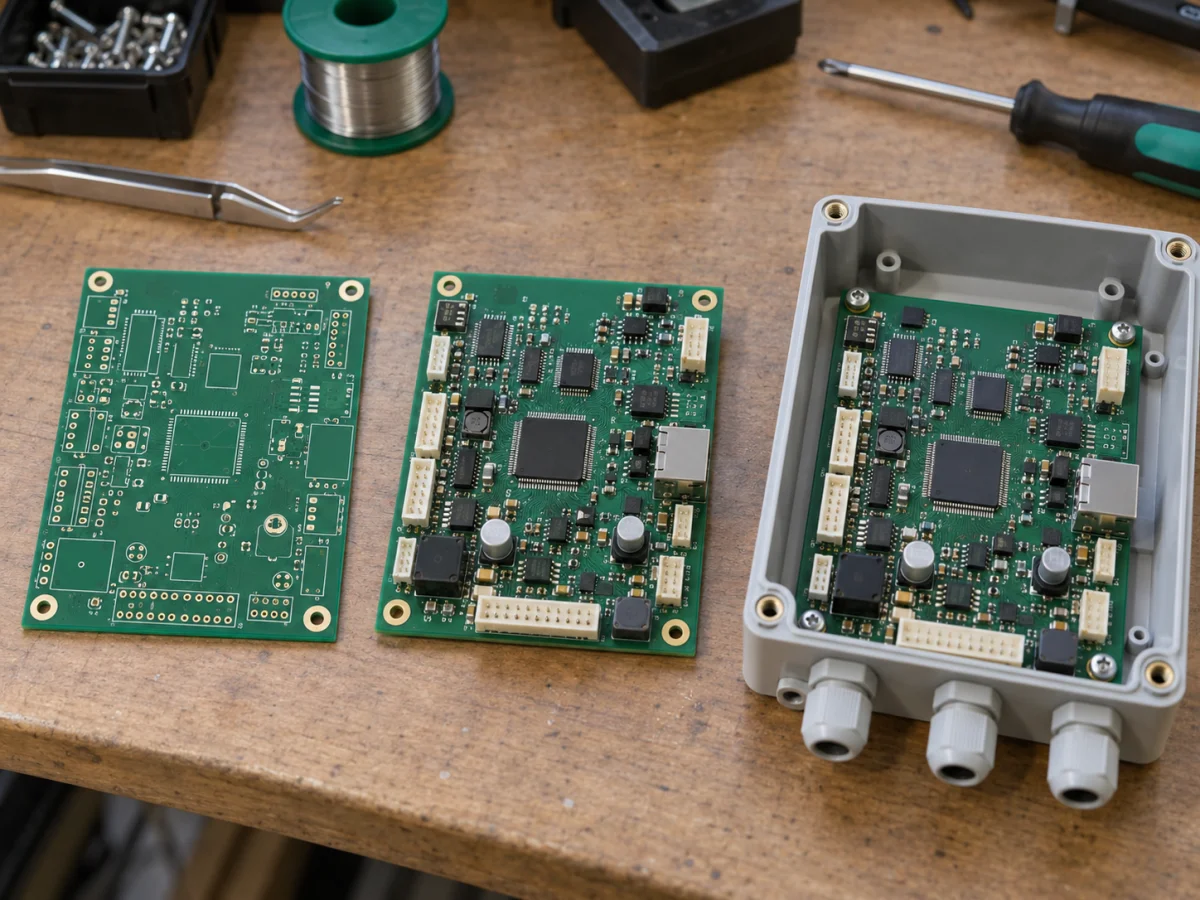
Bare PCB, assembled board and enclosed prototype stages of a custom electronics project
Representative application image.
BeginningAn idea or an existing design
ScopeBoard + software + testing
DeliverySource and manufacturing files

VOMRO engineering approach

First, explain what the board should do; we can define the technical solution together.

You do not need a circuit diagram for the first discussion. A requirement such as 'I want to read three sensors on this machine and show their readings on a display' or 'My device should keep recording measurements when the internet connection fails' is enough to begin. Engineering translates that expectation into interfaces, operating rules, board dimensions and verifiable results. This avoids attempting to price a project solely from a board photograph or approximate dimensions.

This page helps you choose a service and prepare a project. It addresses the decisions involved in commissioning a custom board for your business, rather than explaining how to make a circuit at home. See the relevant service page for details of our electronics and embedded software work. If you only need bare PCBs made from existing files or standalone contract assembly, that is outside VOMRO's standalone service scope.

01

What is the difference between circuit design, PCB fabrication and a working product?

Electronic circuit design determines which components the board uses and how it works. The schematic defines electrical connections, while PCB design turns the circuit into a physical board of defined dimensions. A PCB is the printed circuit board to which components connect. Commissioning PCB fabrication may mean obtaining bare boards from existing manufacturing files. Processors, resistors and connectors require separate component procurement and assembly. A 'PCB price' and the cost of developing a working device therefore describe different scopes.

If you are looking for a turnkey PCB solution, clarify what you will receive at the end of the quotation's scope. Processor-based boards also need embedded software for functions such as sensor measurement, displays and communication. Identify separately whether electronics design, software, prototypes and testing are included. If you need a mobile app or server dashboard, their scope must also be specified. Define the expected delivery concretely, such as 'a working control board with software installed and tested with the sensor and display'.

  • Idea: a description of the problem the device will solve
  • Circuit schematic: the design of components and electrical connections
  • PCB: board layout based on the schematic and manufacturing data
  • Working prototype: an assembled board, programmed if required, with the specified functions tested
02

What is needed to commission an electronic circuit and PCB?

To commission an electronic circuit, first describe who will use the product, where and for what purpose. What will users see when they turn it on, which measurements will it take and which actions will it perform? For a tank-monitoring device, for example, level measurement, a local alert and remote reporting are distinct functions. Separate essential features for the first version from later additions. Describing the user flow in a few sentences is more useful than choosing a processor model. If a similar product exists, you can indicate which functions you like and what you would change.

If known, include the power source, connected sensors and motors, approximate enclosure size and initial production volume. Indoor or outdoor use, a moving machine and battery operation lead to different design decisions. If you have not chosen between Wi-Fi, Bluetooth, LoRa or cellular connectivity, describe where the data should go and how often. Technical choices can follow those requirements. Leave unresolved points open; before quotation, we can decide together how to clarify them.

For example, your initial request could say: 'I would like a custom circuit board that reads two sensors on my machine, shows the readings on a display and records them remotely. I plan a few prototypes initially. I do not have technical drawings, but I can share photographs of the machine and its connections.' This starts the technical assessment. The project scope is defined after power, interfaces, board dimensions and acceptance tests have been clarified; production does not begin on assumptions about missing information.

  • Device functions and user flow
  • Connected equipment, power and operating environment
  • Initial prototypes and expected subsequent production
  • Essential features and possible later additions
03

How should you choose a company to develop your circuit?

Companies that make circuit boards do not necessarily provide the same services. Some manufacture bare PCBs from existing files; others assemble components on boards. An engineering company defines the device's functions and develops the circuit and software. Choose according to the files you have and the outcome you need. If you only have an idea, look for a team that takes responsibility for design, software and testing. Comparing a PCB-fabrication-only quotation when you expect a working device would be misleading.

Ask who will design the board, how the first prototype will be evaluated and which files will be delivered. Establish who checks compatibility with the enclosure and connected machine. Confidentiality, revision limits and support after production should be explainable in writing. VOMRO develops circuits, PCBs, embedded software and, where required, mechanical design within the same project. At the start of the discussion, we distinguish standalone PCB fabrication or contract assembly from end-to-end electronics development.

  • Does the quotation deliver a bare PCB, an assembled board or a working device?
  • What is included for software, enclosure compatibility and testing?
  • Are prototype approval criteria and revision conditions documented?
  • Will source files, manufacturing files and technical explanations be delivered?
04

When is a custom PCB the right choice?

Commissioning a custom circuit board means developing its interfaces, dimensions and behaviour around your requirements. A project-specific design can be considered when an available board does not suit your product. Reasons may include removing unnecessary interfaces, reading particular sensors or combining the display and communication on one board. If an available solution meets the need, that option is assessed first. The decision to develop a custom board considers functionality, production volume, maintenance needs and the project's expected life together.

The following examples describe initial needs; the electronics scope and acceptance tests must be defined separately for each. Adding a board to an existing machine involves more than matching the number of connections. Power conditions, the environment, communication and the machine's safe operating arrangements must be assessed together. Explain your application's purpose in the first discussion; the required board architecture and software can then be clarified through technical assessment.

  • Machine control board: sensors, motors, displays and communication with existing automation
  • Measurement and data acquisition board: recording and reporting field data
  • Agricultural machinery electronics: equipment monitoring, measurement and operator information
  • Custom device board: dimensions, interfaces and user controls suited to a product offered under your brand
05

If you want to update or reduce the size of an existing board

You may want to shrink a board in your own product, replace an unavailable component or add a communication feature. Current schematics, editable PCB files, a bill of materials and software sources provide a stronger basis for assessment. State which board revision the files describe. Photographs, connection diagrams and observed problems are also useful. Since standalone operation differs from operation inside a machine or device, information about connected equipment is assessed alongside the board.

If only a physical board or Gerber manufacturing files are available, we first assess the limits of that information. Gerber files do not replace editable schematics or software sources; KiCad also explains that geometry imported from Gerber files does not automatically create a normal PCB design project. If necessary files are missing, documented functionality can establish the scope for a new design. Assessment uses information the customer has the right to share and use. Removing access protections from protected software or copying third-party designs without permission is not accepted as project scope.

06

Enclosures, interfaces and assembly matter as much as PCB dimensions

Fitting within the available space is not enough. Cables must connect, the display must remain visible, buttons must be accessible and mounting screws must not conflict with components. A dimensioned drawing or physical sample is helpful when an existing enclosure will be used. If a new enclosure is being developed, PCB and mechanical layout progress together. The prototype housing can be used to check connector positions, board mounting and service access, revealing the need for major fit-related revisions earlier.

Heat-generating components, motor and power connections, sensitive sensors and wireless antennas affect the layout. Not every project needs the same number of PCB layers or the same protection arrangement. The engineering team assesses these for the intended function and environment; customers are not expected to know detailed PCB design rules. Your role is to describe operating conditions and constraints accurately. Targets such as water resistance, measurement accuracy and operating temperature require appropriate validation on the completed device; choosing an enclosure or component alone does not guarantee them.

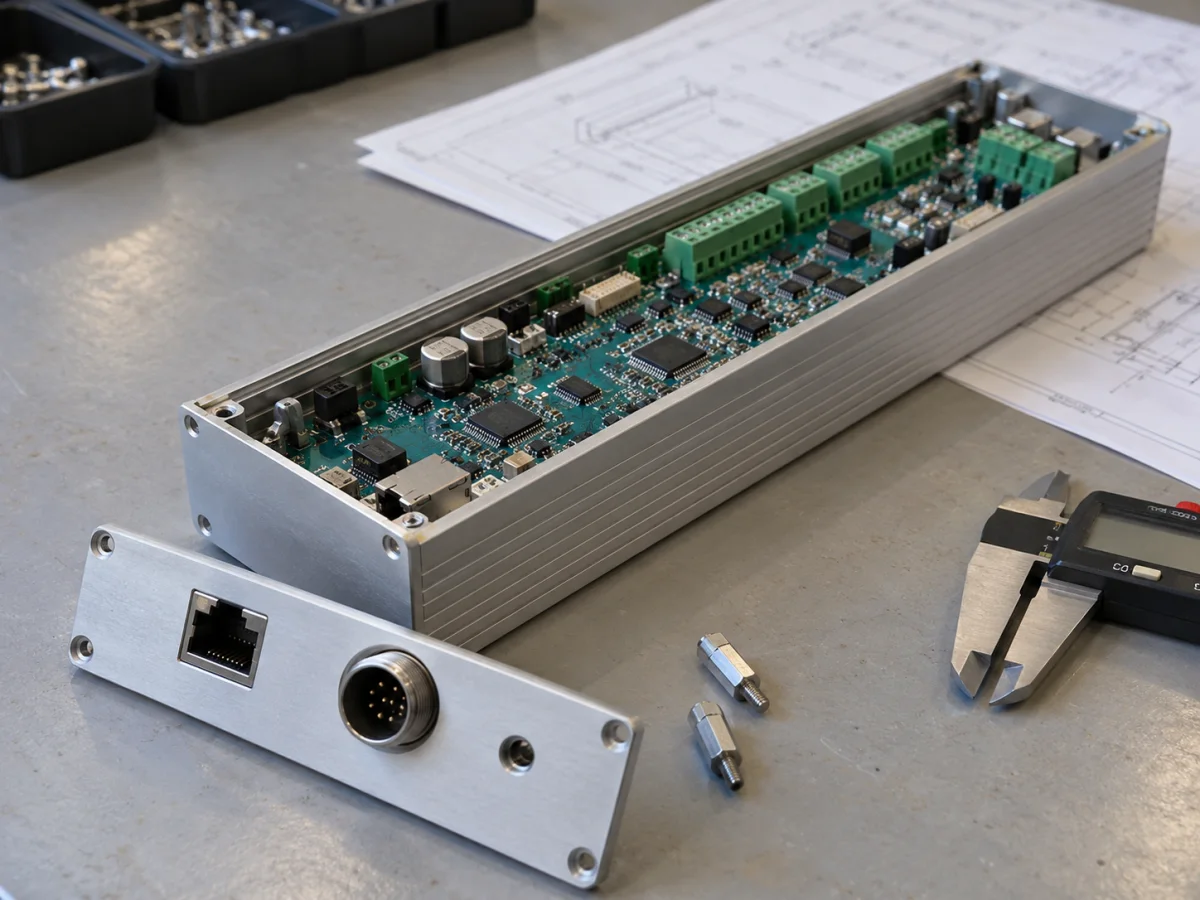
Dimensional compatibility of a custom PCB with its enclosure, connectors and mounting points
Representative application image.
07

How should you assess circuit board development costs and quotations?

Separate the budget into one-time development costs and costs repeated for each manufactured board. The first group covers requirements analysis, circuit and PCB design, software, mechanical work and validation preparation. The second includes bare PCBs, components, assembly, programming, final assembly and production checks. If prototype revisions, test fixtures or external laboratory work are required, their scope should also be stated. The unit cost of a few prototypes is not automatically the price for later series production.

Board dimensions and layer count, component supply, communication features, measurement requirements and production volume affect cost. The schedule includes design approval, component procurement, software and testing, as well as PCB fabrication. Compare quotations using the same feature list and delivery package. Discuss from the outset when revisions count as additional work, how many prototypes are included and which manufacturing files are delivered. A single price or firm lead time quoted without assessment may not cover all your project's needs.

08

Which results are checked on the first working prototype?

For the first prototypes of an approved design, the board is fabricated, components are assembled and required software is installed. Manufacturing outputs, the bill of materials and component placement data must refer to the same revision. The BOM defines which parts to use, while placement data specifies their locations and orientations. Assembly manufacturers' file-preparation guides also emphasise this consistency. At VOMRO, prototype PCB fabrication and assembly support validation of the customer project we develop.

Acceptance uses the project's actual tasks: does the sensor read a known value correctly, does the display show the required information, and are records retained when a connection fails? Behaviour after power loss and recovery, operation with target loads and use inside the enclosure are also tested as required. Results are recorded with hardware and software versions. Issues found in the first prototype enter the revision plan. A demonstration sample and a device validated for production and operating conditions are different stages; the next decision follows the acceptance results.

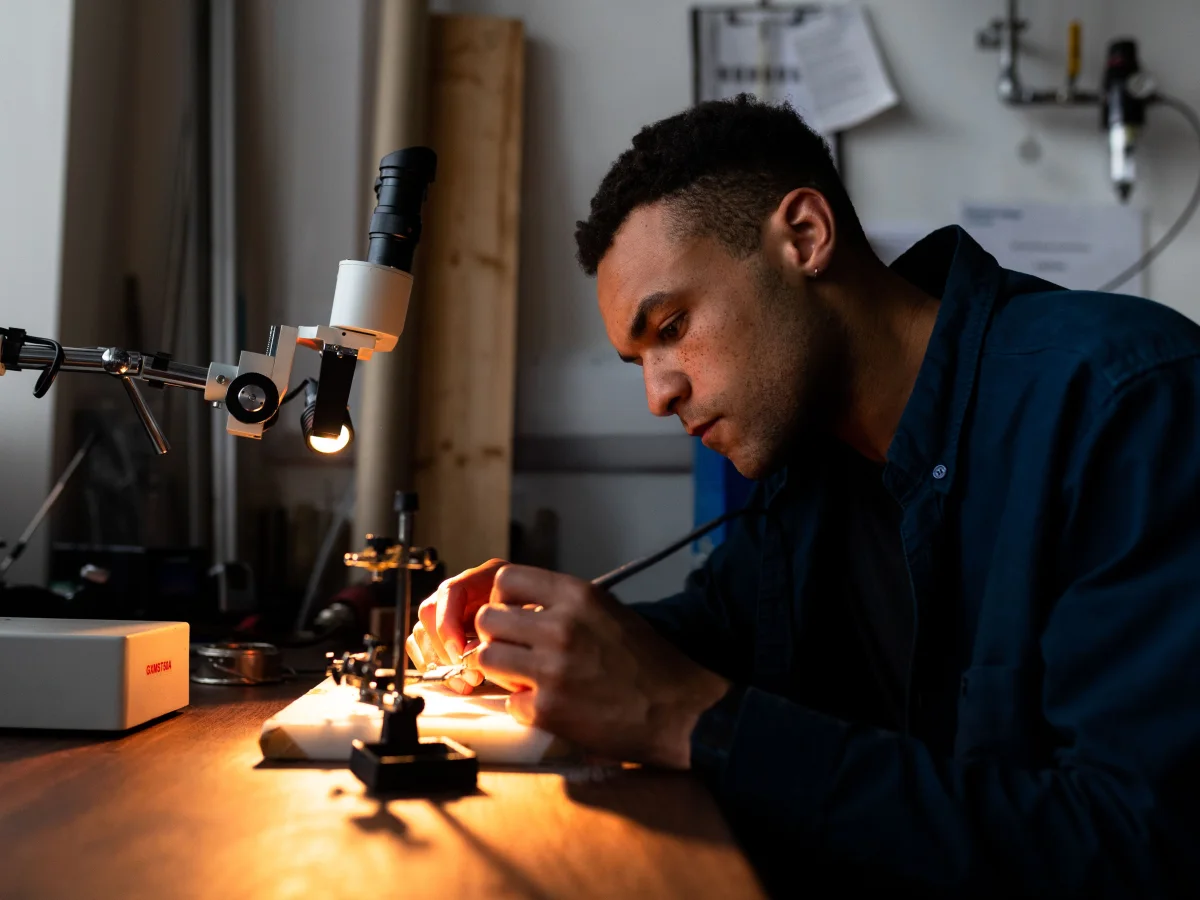
An engineer working on electronic components under a microscope and task lighting
Work on electronic components using a microscope and precision hand tools.
09

Plan the transition from prototype to repeat production from the outset

Once the first board is approved, a manufacturing package enables subsequent batches to be prepared consistently. Component part numbers, board revision, software version and required settings must be clear. If product identity or calibration data are used, the loading method is documented. A setup for checking each board's basic functions is planned, along with programming and measurement fixtures where required. Demonstrating that a design works once is different from checking every manufactured board.

The first batch is assessed for ease of assembly, testing time and field feedback. A component affected by supply changes is not replaced without assessing the alternative; required validation and version updates are completed. If production demand is uncertain, prototypes and pilot quantities sufficient for the next decision can be chosen instead of a large batch. When an enclosure or mechanical part is developed alongside the board, revisions are matched. Production methods and costs are updated as sales and operating results become clearer.

10

Clarify the NDA and source file delivery

At your request, we can work under an NDA before you share your product idea and technical details. VOMRO provides engineering services to develop the customer's project; we do not add your custom-developed project to our own off-the-shelf product catalogue. Sharing project images or details as references requires separate permission. You can describe the general objective initially and provide confidential documents after the agreement. We also determine which files are genuinely needed for assessment at this stage.

At project completion, we deliver the source code, editable schematic and PCB designs, mechanical CAD files and technical documentation developed within scope. The delivery list specifies manufacturing outputs such as Gerber and drill files, the BOM, build and programming instructions, and test records. Third-party libraries and tools are explained with their own licensing conditions. To begin, describe the device's purpose, current status and target volume; through technical assessment, we can define development scope, acceptance criteria and the delivery package together.

Which stage does your circuit board project request correspond to?
What do you already have?Initial requirementExpected outcome
Product idea or requirements descriptionDefining functions and operating conditionsDevelopment scope and acceptance criteria
Your existing board and its source filesRevision and redesign assessmentUpdated design and validation plan
A project with an approved development scopeElectronics, software and prototype developmentA prototype tested against defined tasks
Approved prototypeManufacturing package and checks for every boardRepeat production with traceable versions

How it works

Turn decisions into a project plan.

Not every project looks the same; however, the measurable requirement, controlled revision, and field verification steps remain unchanged.

  1. 01

    Describe your requirements

    Explain what the device should do, where it will be used and its current status.

  2. 02

    Let's define the scope

    Define design, software, prototypes, testing and delivery within a single quotation.

  3. 03

    Let's test the prototype

    Check the prototype against predefined functions and acceptance conditions.

  4. 04

    Let's deliver the source files

    Prepare source and manufacturing files for the approved version, with explanations.

Frequently asked questions

Before starting the project

The technical scope, deliverables and test plan are clarified together according to the requirements of your project.

Can I commission a custom board without electronics knowledge?

Yes. For the first discussion, simply explain what you want the device to do and where it will be used. You do not need to draw schematics or choose a processor. During technical assessment, we define functions, interfaces, development scope and acceptance conditions together.

Is commissioning a printed circuit board the same as commissioning working electronics?

They have different scopes. PCB fabrication usually means producing bare boards from existing files. A working electronic board also requires circuit and PCB design, components, assembly, software where needed and functional testing. Explain which information and files you already have and what you expect to receive.

Can I commission software and an enclosure together with my custom PCB?

Yes. Depending on the requirements, VOMRO can combine circuit design, embedded software, mechanical and industrial design, and prototyping. A mobile application or server dashboard can also be included. The quotation explains which work, prototypes and tests are included.

Is there a fixed price for commissioning a circuit board?

No single price covers every project. Design and software scope, interfaces, mechanical requirements, prototype quantities and testing affect development costs; PCBs, components, assembly and programming affect production costs. The quotation is prepared after these items and the delivery package are defined.

Can we begin with just a prototype?

Yes. The first stage can be a prototype that validates specific functions. Prototype quantity and testing scope are agreed together. The production decision depends on prototype results, required revisions and expected future quantities.

Does my Gerber file contain the software and circuit schematic?

Gerber files primarily contain PCB manufacturing data; they do not replace editable schematics or firmware sources. We assess what can be done with the available files. Design changes may require additional sources or new engineering work.

Do you provide PCB fabrication or contract assembly alone from my existing files?

We do not offer standalone contract PCB fabrication or assembly. We provide this support only for prototyping, validation and production preparation within customer projects developed by VOMRO. If your request also includes developing or updating the board, we can assess the project scope.

Will my custom electronics project remain confidential, and will I receive the source files?

At your request, we can work under an NDA before technical details are shared. At project completion, we deliver the source code, editable schematic and PCB files, and relevant mechanical and technical documents developed within scope. Third-party tool licence conditions are stated separately; sharing your project as a reference requires your permission.

Your project, your product

Developed confidentially and delivered with source files.

We may work with a confidentiality agreement (NDA) before sharing technical details. At the end of the project, we deliver the source codes, design files and technical documents we have developed to you.

  • NDA before sharing technical information
  • Clear deliverables agreed at the outset
  • Source and technical files at the end of the project
Our confidentiality and delivery process
Let's start with your idea

Let's talk about the product you dream of and the need you want to solve.