
Computer architecture suitable for your workload and device

Custom computer systems and server-specific PCIe board development

The dimensions, connections or operating conditions of a standard computer may not suit your project. VOMRO develops custom-form-factor computer systems, carrier boards for processor modules and PCIe boards that connect to servers. We consider CPU/GPU selection, DDR memory requirements, data flow, embedded software and the enclosure within the same project. For high-performance computing applications, we plan the solution using measurements from the actual workload rather than component catalogue specifications alone.

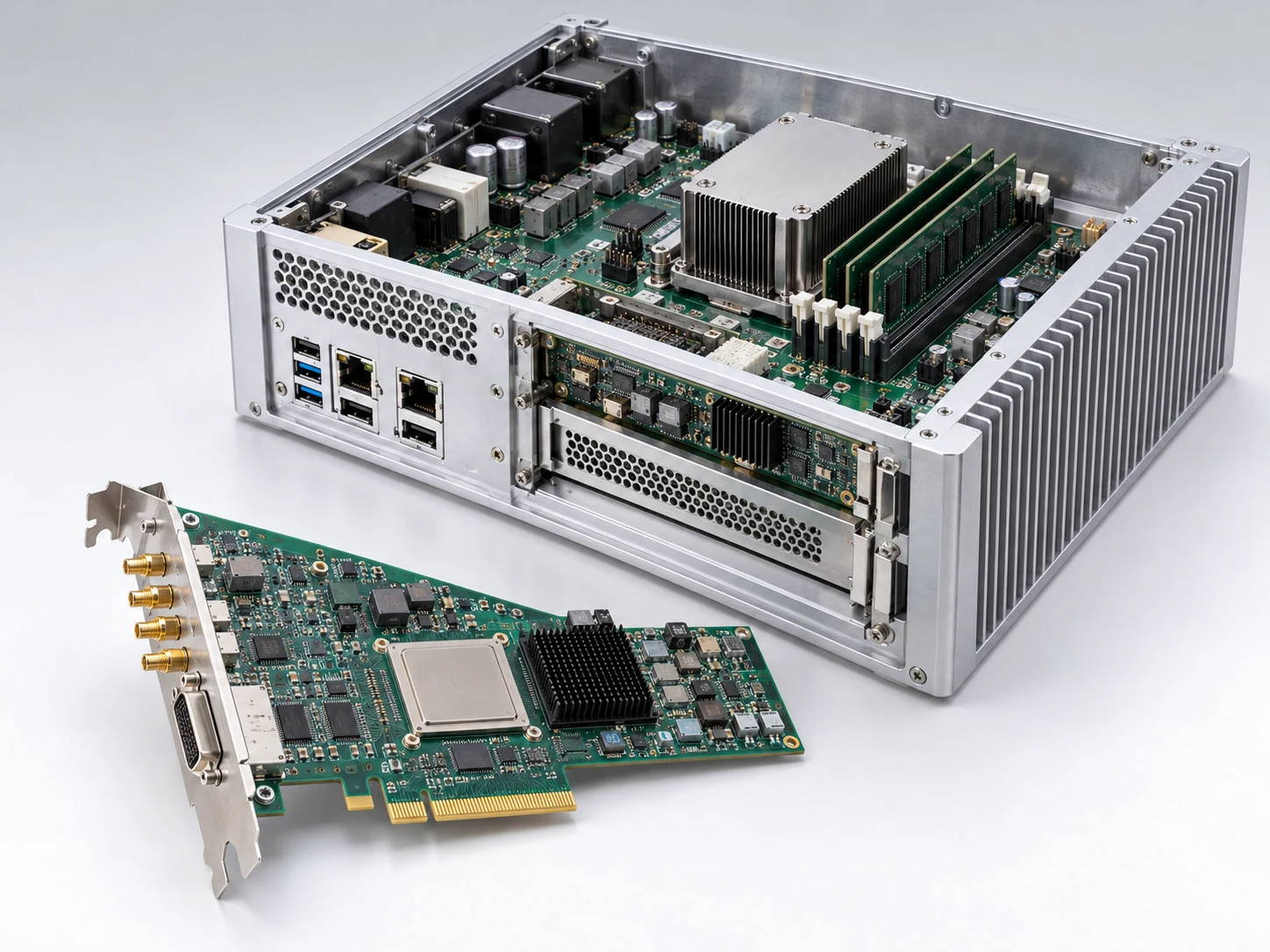
Processor heatsink, DIMM memory modules and a custom PCIe board in an open aluminium industrial computer enclosure
Representative application image.
ArchitectureCustom board or module integration
ScopeElectronics, software and mechanics
VerificationActual workload and target server

Your project, your product

Developed confidentially and delivered with source files.

We may work with a confidentiality agreement (NDA) before sharing technical details. At the end of the project, we deliver the source codes, design files and technical documents we have developed to you.

  • NDA before sharing technical information
  • Clear deliverables agreed at the outset
  • Source and technical files at the end of the project
Our confidentiality and delivery process

VOMRO engineering approach

We start with requirements that an off-the-shelf computer cannot fit or meet.

A machine vision computer that must fit inside a narrow machine body, a server board that must acquire continuous data from a measurement instrument and a carrier board that combines specialised field connectors present different engineering challenges. In the first discussion, we define the data being processed, response times, interfaces, size limits and target production volumes. The solution may require a completely new circuit board or the integration of an existing processor module with a custom board and enclosure.

We use available CPUs, GPUs, memory and related components to develop a circuit board and computer architecture suited to your project. Feasibility assessment covers access to platform documentation, manufacturer support, licence conditions and availability. At your request, we sign an NDA before technical information is shared and include the source files to be developed and acceptance conditions in the quotation scope.

01

Which requirements can a custom-sized computer meet?

A desktop motherboard layout may be unsuitable for an industrial device, robot, test system or machine vision system. Screw holes, display connections, cable routing, service access and power inputs matter as much as the board's external dimensions. For a custom computer, we assess these together with the processing performance required by the application. Operating temperature, vibration, dust and use inside a closed enclosure are design inputs.

The aim is not simply to make a smaller board. We also plan for module replacement during servicing, preventing incorrect connector insertion and repeatable production assembly. An off-the-shelf industrial computer or processor module may be recommended when appropriate for cost, development time and long-term availability.

  • Custom board placement inside machines and devices
  • Custom connections, power input and mounting arrangement
  • Accessible mechanical design for production and servicing
02

How do you choose between a new board design, a carrier board and a backplane?

A carrier board connects a suitable computer module containing the processor and memory to the interfaces required by the device. Power input, communication, storage, cameras and other peripherals can be arranged for the project. A backplane provides a shared interconnection structure for multiple boards. A mezzanine board can also add functionality to an existing design.

Developing a processor board from scratch can require a broader scope for documentation access, memory layout, boot software and validation. Using a module can reduce some of this work, but the carrier board still requires hardware and software adaptation to operate correctly. We choose the architecture according to target volumes, product life, interface requirements and the development budget.

  • A module with a project-specific carrier board
  • Backplanes and mezzanine boards for multi-board systems
  • Electronics developed from scratch where the project justifies it
03

What can a custom PCIe card connected to a server do?

A custom PCIe card can be considered for measurement data acquisition, multichannel recording, device interfaces or data preprocessing with suitable hardware. For example, a board that organises sensor data on an FPGA and transfers it to a server could provide a project-specific data acquisition solution. An FPGA is a programmable logic device; whether it is needed depends on data rates, timing and processing requirements.

At the outset, we examine the target server model, available PCIe lanes, slot power, card height and airflow. The PCIe version and lane count alone do not guarantee application throughput. The board, server and software are tested together. The older PCI interface is different from PCIe; requests involving legacy systems require a separate technical assessment.

  • Data acquisition, custom device interfaces and recording boards
  • FPGA and accelerator interfaces where appropriate for the project
  • Mechanical, electrical and software validation with the target server
04

How are CPU, GPU and DDR memory requirements determined?

The CPU handles the general processing flow and application tasks. A GPU can accelerate parallel computation when supported by the software. DDR memory provides working space for the application and its data. Choosing a large GPU alone will not improve an application if data cannot reach memory or the GPU quickly enough. Image size, channel count, concurrent tasks and the permitted response time must be considered together.

DDR generation, capacity and operating speed are constrained by the selected processor's memory controller, memory components and board architecture. Unconditional compatibility with every DDR version or GPU cannot be promised. Candidate platforms are tested with the actual software and sample data, allowing a measurable choice between unnecessary hardware expense and insufficient capacity.

  • Processor and accelerator selection based on the application
  • Assessing data transfer requirements as well as memory capacity
  • Checking the platform's documentation and software support
05

Why should high-speed PCB design and cooling be considered together?

For interfaces such as DDR and PCIe, a correct schematic is not enough. PCB layer stack-up, controlled impedance, interconnect losses, clock signals and the power supply's response to load changes must be assessed. Signal and power integrity work follows the selected components' requirements. Required simulations, measurement capabilities and acceptance limits are included in the project plan before design begins.

Heat from the processor, memory and power circuits affects both board layout and enclosure design. Fans, heatsinks and heat transfer to the enclosure are evaluated for the operating environment. Sustained-load testing monitors performance reduction, restarts and connection errors. A prototype that works on an open bench is not assumed to behave identically inside a closed device.

  • PCB layers and routing rules appropriate to the components
  • Power sequencing, power distribution and startup checks
  • Sustained-load and temperature testing inside the enclosure
06

How is operation under Linux or Windows implemented?

Having a computer recognise a custom board is not the same as obtaining reliable application data. The Linux or Windows driver, FPGA logic, board startup sequence and application interface are planned together. For large data transfers, DMA can reduce the processor's burden of moving each item individually, but buffer management and error behaviour still need to be designed. Target operating systems and versions are defined at the start of the project.

Testing covers kernel or driver updates, device restarts and operation under heavy load. If Windows driver signing or manufacturer-specific development tools are required, their access conditions and costs are explained. Development involving closed CPU/GPU interfaces remains within the scope permitted by the available documentation and licences.

  • Board software, drivers and application interface
  • Operating system and version compatibility list
  • Interruption, fault logging and update scenarios
07

Which tests take a prototype to a usable system?

A small initial experiment can demonstrate the critical data path or interface. The next prototype combines the actual board, target server, power supply and enclosure. Acceptance criteria include data throughput, total response time, data loss, operating temperature and recovery from interruptions. Results are recorded with the hardware, software and test data used.

Using certified components or components that have passed conformity tests does not automatically establish conformity of the completed device. Electrical safety, EMC and other assessments required for the product's market and intended use are planned separately. Pilot production checks repeatability of assembly and testing; the decision to enter series production is not based solely on the first working board.

  • Initial experiment, electronics prototype and target system testing
  • Recorded acceptance tests for workload, temperature and fault conditions
  • Product-level conformity and pilot production plan
08

How are confidentiality, source file delivery and quotation scope defined?

To begin a quotation, describe your process, data sources, size limits, target volume and, if applicable, the server model. We can agree an NDA before you provide technical documents. After assessment, we compare custom board development and existing module integration in terms of initial investment, production cost and product life. Interfaces with unresolved requirements may first need a feasibility or prototype stage.

Project schematic and PCB source files, software developed within scope, FPGA design sources, mechanical CAD and test documentation are provided at project completion according to the contractual delivery list. Third-party IP cores, BIOS/BSP components and tool licences remain subject to their own conditions. Rapid PCB fabrication and assembly support is provided only for customer projects developed by VOMRO.

  • An NDA before technical information is shared
  • Separate decision points for feasibility, prototyping and production
  • Source files and technical documentation delivered as defined in the contract

How it works

A clear process from start to delivery.

Not every project looks the same; however, the measurable requirement, controlled revision, and field verification steps remain unchanged.

  1. 01

    We define the workload

    Together, we define the data, interfaces, dimensions, operating system and acceptance conditions.

  2. 02

    We validate the architecture

    We assess custom board and module options and evaluate critical interfaces through initial experiments.

  3. 03

    We develop the prototype

    We combine electronics, drivers, application software and mechanical design on the target system.

  4. 04

    We test and deliver

    We organise acceptance records, project source files and production documentation according to the agreed delivery scope.

Frequently asked questions

Before starting the project

The technical scope, deliverables and test plan are clarified together according to the requirements of your project.

What kind of system do you develop with CPU, GPU and memory components?

We develop custom circuit boards and computer systems using suitable available processors, memory components or modules. Based on the workload, we jointly define the scope for carrier boards, custom motherboards, PCIe boards, enclosures, cooling and software integration.

Can you design an industrial computer with custom dimensions?

We determine a suitable architecture after assessing dimensions, connections, performance and environmental conditions. A carrier board for an existing module or a new board design can be considered according to documentation access and project feasibility.

Will the developed PCIe board work in every server?

Universal compatibility is not assumed. A compatibility list covers the target server, slot configuration, PCIe version and lanes, power, cooling, firmware and operating system. Acceptance tests are performed on the defined systems.

Can we commission a custom data acquisition board for our existing server?

We assess the sensor or device interface, channel count, data rate, recording duration and target server. Where appropriate, a project can combine PCIe board design, FPGA preprocessing and driver development. The scope is confirmed after feasibility assessment.

Can we receive the source files, and do you sign NDAs?

At your request, we sign an NDA before technical information is shared. Project schematic/PCB files, software, FPGA and CAD sources developed within scope, and technical documentation are delivered according to the contractual delivery list. Third-party licensing conditions are explained separately.

Let's start with your idea

Let's talk about the product you dream of and the need you want to solve.