
From the need for computation to the right hardware

What is HPC? How to choose a CPU, GPU, DDR and PCIe architecture

HPC stands for High Performance Computing. It describes performing demanding computational tasks using suitable processors, accelerators, memory and software together. What matters for your business is whether the system completes the required work within the specified time and operating conditions, not whether it is labelled HPC. This guide explains the roles of CPUs, GPUs, DDR memory and PCIe connections through the decisions involved in commissioning a custom computer or server board.

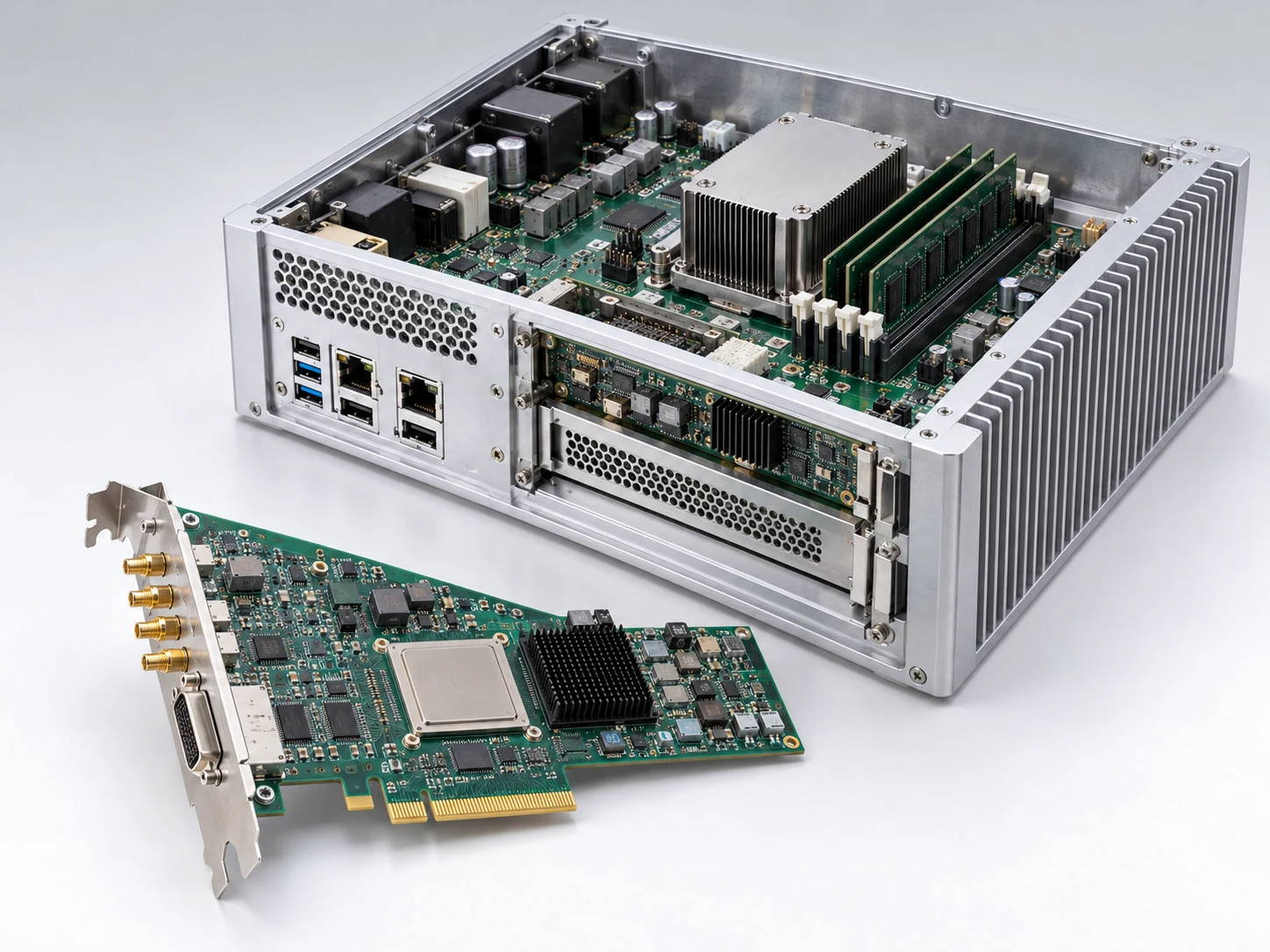
CPU cooler and DIMM memory modules in an open aluminium industrial computer enclosure, with a server-specific PCIe board beside it
Representative application image.
HPCHigh-performance computing
SelectionWorkload, data and operating conditions
SuccessMeasured application performance

VOMRO engineering approach

First, define what the computer must do and how quickly it must do it.

Inspecting production-line camera images, recording many sensors and running engineering simulations do not require the same computer. Even with the same data volume, processing methods and deadlines can differ. Comparing quotations only by processor model or memory capacity is therefore incomplete. The requirements should include a real data sample, the expected output and an acceptable completion time.

HPC can run on a single powerful computer or a cluster of computers working together. Not every custom industrial computer is an HPC system; sometimes the main requirements are dimensions, interfaces or reliable field operation. A custom board project assesses how available processor and memory components or modules can be combined in an architecture appropriate to the application.

01

When is HPC useful, and does every project need it?

Running many calculations concurrently, analysing large datasets and completing lengthy simulations are among the uses of high-performance computing. However, powerful hardware does not accelerate every task by the same amount. The application must be able to divide the work, data must reach the processing units, and the software must make use of the selected hardware. A large GPU server may be unnecessary for a small data acquisition task.

The first step is to measure where the existing process slows down. Is the processor calculating, waiting for memory, or delayed by disk writes? Setting a millisecond target when a result within seconds would suffice can increase costs. It is better to base the investment decision on the actual task's total duration and the business's acceptance requirements.

  • Distinguish intensive computation from large data volumes
  • Measure the source of delays in the existing system
  • Set time and cost targets alongside output quality requirements
02

What does the difference between CPU and GPU mean for the customer?

The CPU is the computer's general-purpose processor; it handles application flow, the operating system and many different tasks. A GPU can perform many suitably structured calculations in parallel. Image processing, AI and numerical computation software can benefit if they support the GPU. Installing a powerful GPU may not produce the expected result when the software cannot use it.

Training an AI model and running a trained model on a device are different workloads. Hardware required in the training server may not be necessary in every field device. Data transfer time between CPU and GPU must also be included in the overall calculation. Candidate hardware should be compared using the same data, output quality and execution-time target, rather than selected solely on the speed quoted in a manufacturer's benchmark.

  • CPU: general application flow and varied tasks
  • GPU: parallel computation with suitable software
  • Total execution time in the actual application, including data transfer
03

Is looking only at gigabytes enough when choosing DDR memory?

DDR is a family of computer working-memory technologies. Capacity affects how much data can be processed at once, while memory bandwidth concerns how quickly data can be moved. Both matter when processing many images or measurement records. GPU memory and system DDR memory are separate resources; transfers between them must also be assessed.

DDR4, DDR5 and low-power LPDDR options depend on the platform and are not directly interchangeable. The processor's memory controller determines the supported generation, speed and interface structure. Routing and timing rules on a custom PCB must also match that selection. Large capacity or a newer memory generation does not alone guarantee application performance; the target configuration must be tested with the actual workload.

  • Capacity appropriate to the working data
  • Bandwidth appropriate to the data flow
  • Compatibility between the processor, memory and PCB design
04

Are PCI and PCIe the same, and what is a custom server board?

PCI is an older parallel interconnect architecture; PCI Express, or PCIe, uses serial links. Similar names do not mean the cards fit the same slot. A photograph of the slot, server model and specifications are therefore important when requesting a custom server board. A solution for a legacy PCI system and a new PCIe design require separate assessments.

The x1, x4, x8 and x16 designations in PCIe indicate the number of lanes. Actual transfer performance depends on the supported version, electrically connected lanes, board and server capabilities, and software overhead. A physically long slot does not guarantee that the corresponding number of lanes is connected. A custom PCIe board can act as a server-accessible endpoint for data acquisition, interfaces or preprocessing; it is not automatically compatible with every server and operating system.

  • Separate hardware assessments for PCI and PCIe
  • Checking actual lane connections as well as slot dimensions
  • A custom board validated with the target server and software
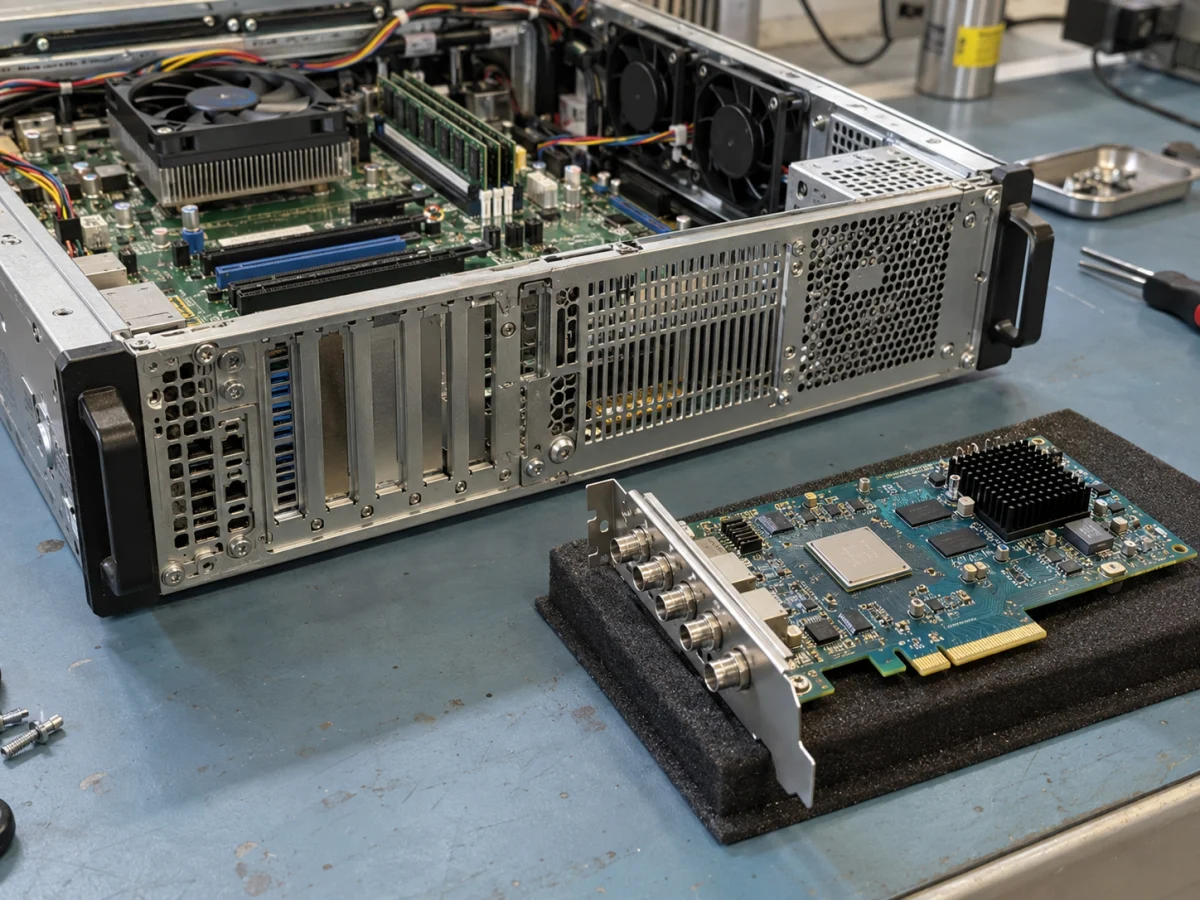
Checking the mechanical fit and interface compatibility of a custom PCIe expansion card with an industrial computer enclosure
Representative application image.
05

What do FPGA and DMA do in a data acquisition project?

An FPGA is programmable hardware that can be configured to perform particular tasks. In a suitable project, it can time sensor data, combine channels or process data before sending it to a computer. FPGA selection considers more than speed: required inputs, memory, development tools and validation work also matter. A simpler task may be better addressed using another electronic architecture.

DMA helps transfer data to or from memory without involving the processor to the same extent in every transfer. It does not automatically eliminate data loss. Behaviour must be defined for full buffers, a busy server and an application that cannot keep up. For measurement recording, acceptance may require complete data capture over a long period and clear error reporting, rather than only a high peak transfer rate.

  • Data timing and preprocessing suited to the requirements
  • Controlled transfers between the board, driver and application
  • Checking data loss and buffer behaviour under heavy load
06

Is an available module or a custom motherboard more suitable?

A processor module can provide much of the computing subsystem as an existing design. A project-specific carrier board adapts it to the device's power, connection and mounting requirements. Custom carrier-board adaptation documentation for platforms such as NVIDIA Jetson also addresses hardware checks and software together. Using a module does not make the carrier board a passive part that simply joins connectors.

A motherboard designed from scratch can offer more customisation, but it may also require broader memory, boot software, manufacturing and validation work. Initial investment differs from repeat production costs. Target volume, availability, manufacturer support and time to market must be compared together. Technical documentation or interfaces for some CPU/GPU platforms require special access and licensing; the scope is not finalised until these are verified.

  • Development time and initial investment
  • Unit cost and long-term component supply
  • Manufacturer documentation, licences and software support
07

Why are the enclosure, cooling and drivers part of system performance?

A board running briefly in an open environment is not necessarily ready for continuous operation inside a device. As temperatures rise, processor frequency may decrease and power or connection problems may appear. Internal airflow, heatsinks, fans, cables and service clearances are designed together. Fanless operation requires additional assessment of heat transfer to the enclosure and environmental conditions. Mechanical design should not be treated as a cover added after the electronics are finished.

Drivers and the operating system are part of the same system. Define the Linux kernel or Windows version, boot software and application libraries. Test behaviour after updates and recovery from interruptions. A component's certification does not replace EMC or safety assessment of the completed device; a separate conformity plan is prepared for the product's intended use.

  • Sustained-load testing in the final enclosure
  • Target operating system and driver versions
  • Product-level validation and maintenance plan
08

Which information and deliverables should you request in a quotation?

Specify sample data, channel count, required response time, environmental conditions, dimensions and target volume. For a server-installed board, provide the server model; for a GPU application, identify the existing software. Ask the quotation to explain architectural options, uncertainties and what the prototype will validate. Separate criteria for the initial test, pilot production acceptance and system delivery make decisions easier.

When working with VOMRO, an NDA is signed at your request before technical information is shared. Project schematic/PCB files, software, FPGA sources developed within scope, mechanical CAD and technical documentation are delivered as specified in the contract. Third-party component licences are stated separately. PCB fabrication and assembly are offered only for customer projects we develop. The aim is a delivery package that helps you operate the device and plan its maintenance, repeat production and future versions.

  • Actual data, timing targets and system constraints
  • Measurable prototype and system acceptance conditions
  • Source files, test reports and a licence list
Computer architecture components and what to discuss in a quotation
ComponentMain roleQuestion to ask
CPURuns the general application flow and calculations.Does my actual software meet the required execution time?
GPUCan accelerate parallel computation with suitable software.Are software support and total data transfer time suitable?
DDR memoryHolds the application's working data.Are capacity and bandwidth sufficient for my workload?
PCIe cardConnects the computer to custom device functions.Has it been tested with the target server, power supply and driver?
Carrier boardAdapts a processor module to the device's interfaces.Have power, startup and peripherals been validated together?

How it works

Turn decisions into a project plan.

Not every project looks the same; however, the measurable requirement, controlled revision, and field verification steps remain unchanged.

  1. 01

    Describe the task

    Start with sample data, timing targets, interfaces and device operating conditions.

  2. 02

    Compare the options

    Measure CPU/GPU, module and custom board options with the actual application.

  3. 03

    Test the system

    Evaluate sustained operation and fault scenarios in the target server and enclosure.

  4. 04

    Define the delivery package

    Specify source files, licences, acceptance records and maintenance information in the contract.

Frequently asked questions

Before starting the project

The technical scope, deliverables and test plan are clarified together according to the requirements of your project.

Does HPC mean a high-speed computer?

HPC stands for High Performance Computing. It describes running demanding workloads using appropriate computing resources. A computer with a high clock frequency, or any custom computer design, is not necessarily an HPC system.

Is a GPU always required for HPC or AI?

No. A CPU may meet the workload's requirements. The benefit of a GPU depends on software support, whether the calculations can run in parallel, memory and data transfers. Selection should be based on measurements with the actual application and data.

Can a PCI card be inserted directly into a PCIe slot?

No. PCI and PCIe have different interconnect architectures and physical interfaces. Whether a bridge or another solution can support an older card in a newer system requires a separate assessment of the card, driver and application.

Does newer DDR memory always make an application faster?

No. The memory supported by the processor, board architecture, capacity and the application's data access patterns all matter. A memory generation unsupported by the platform cannot be used directly; performance must be measured in the target configuration.

Are source files also delivered for a custom computer project?

In VOMRO projects, project electronics, software, FPGA sources developed within scope and mechanical source files are provided according to the contractual delivery list. Test and installation documents are prepared, and the conditions for licensed manufacturer and third-party components are explained separately.

Your project, your product

Developed confidentially and delivered with source files.

We may work with a confidentiality agreement (NDA) before sharing technical details. At the end of the project, we deliver the source codes, design files and technical documents we have developed to you.

  • NDA before sharing technical information
  • Clear deliverables agreed at the outset
  • Source and technical files at the end of the project
Our confidentiality and delivery process
Let's start with your idea

Let's talk about the product you dream of and the need you want to solve.