
Engineering for fields, machinery and facilities

Electronics and software development for smart farming systems

We develop customer-specific smart agriculture technologies for devices that receive data from agricultural machines, greenhouse and irrigation control units, livestock and storage sensors. We plan the electronic circuit board, embedded software, field communication, mechanical protection and server application together with the requirements of your agricultural process. We proceed with prototypes and field validation for your own brand or customer project.

Installation of field sensors and meteorological measurement station
Agricultural measurement and field sensors
ApplicationField + machine + facility
DevelopmentElectronics, software and mechanics
DeliverySource and technical files

Your project, your product

Developed confidentially and delivered with source files.

We may work with a confidentiality agreement (NDA) before sharing technical details. At the end of the project, we deliver the source codes, design files and technical documents we have developed to you.

  • NDA before sharing technical information
  • Clear deliverables agreed at the outset
  • Source and technical files at the end of the project
Our confidentiality and delivery process

VOMRO engineering approach

The work itself defines the smart agriculture project before the device.

While a planter manufacturer may want to monitor seed flow, a business may want to record the feed preparation cycle, and another company may want to collect measurements from different points of the grain warehouse. What these needs have in common is that they use sensors; measurement speed, energy source, operator intervention and mechanical layouts are not the same. That's why we don't evaluate agricultural technologies only through irrigation automation. We start the project by examining how the process to be measured or managed works.

For agricultural machinery manufacturers, agricultural technology startups and businesses developing their own solutions, we can plan work ranging from a focused sensor interface to a complete device architecture. The customer's field knowledge becomes an input/output list, user workflow, data model and acceptance tests. Expected production quantity, target cost, servicing method and existing-system connections are also part of the plan. The aim is to turn a demonstration prototype into a documented design that can be prepared for actual use.

01

Electronics and control for agricultural machinery from planting to harvest

Custom electronics projects can be developed for combine and forage harvesters, seed drills and planting equipment, sprayers and fertiliser spreaders, balers and feed preparation units. Orchard and vineyard machinery, potato and beet harvesting equipment and post-harvest processing systems can also be considered. Self-propelled, tractor-mounted and stationary machines have different connection and operating requirements. We define the scope of the custom control board, sensor module and operator display accordingly.

A CAN connection does not imply access to the same data on every machine. Make, model, year, electronic control unit and manufacturer documentation are assessed. CAN, J1939 and ISOBUS requirements are not treated as interchangeable promises; an ISOBUS project particularly requires review of target functions, licensed software options and terminal interoperability. Scope is prepared for auxiliary measurement, data transfer or defined equipment control while preserving the machine manufacturer's safety architecture.

  • Sowing, planting, spraying and fertilizing equipment electronics
  • Measurement and telemetry for combines, forage harvesters and other harvesting machines
  • Custom interfaces for baling, feeding, orchard and crop-processing machinery
02

Precision agriculture, process monitoring and field data collection

In precision agriculture, location records become meaningful when combined with measurements of the work performed. Operating time, machine status, application quantity and relevant field information can share a timeline. GNSS records alone do not guarantee an accurate calculation of the area sown or sprayed; working width, active equipment time, overlap and data validity must also be included. The required report's inputs and calculation method are documented at the outset.

For example, separately recording a sprayer's target dose and measured flow is more informative than retaining only the setpoint. In sowing, target density and sensor-counted passages are also different quantities. Criteria set by the agricultural application specialist become explicit data fields in the electronics and server software. Reports identify incomplete, estimated or calibration-dependent data; unmeasured outcomes are not presented as confirmed performance results.

03

Smart irrigation, measurement and control projects for fields and greenhouses

Measurements such as soil moisture and temperature, ambient humidity, water pressure, flow rate, tank level, EC or pH are taken into the system according to the intended use. Data sharing with ventilation, lighting or existing air conditioning unit in the greenhouse can also be considered. The location, contamination, calibration and replaceability of the sensor are as important as the selection of the sensor. Instead of assuming that a single measurement point represents the entire land, a field plan is prepared to show the differences.

Irrigation control defines the electrical interfaces of the pump, valves and fertilisation unit. Local schedules, measurement-based decisions and remote commands are distinguished. The project defines which rules continue without internet, how the system starts after power returns and what happens when measurements are invalid. This prevents control from depending solely on server commands. Agricultural decision rules are validated using the customer's expertise and field trials.

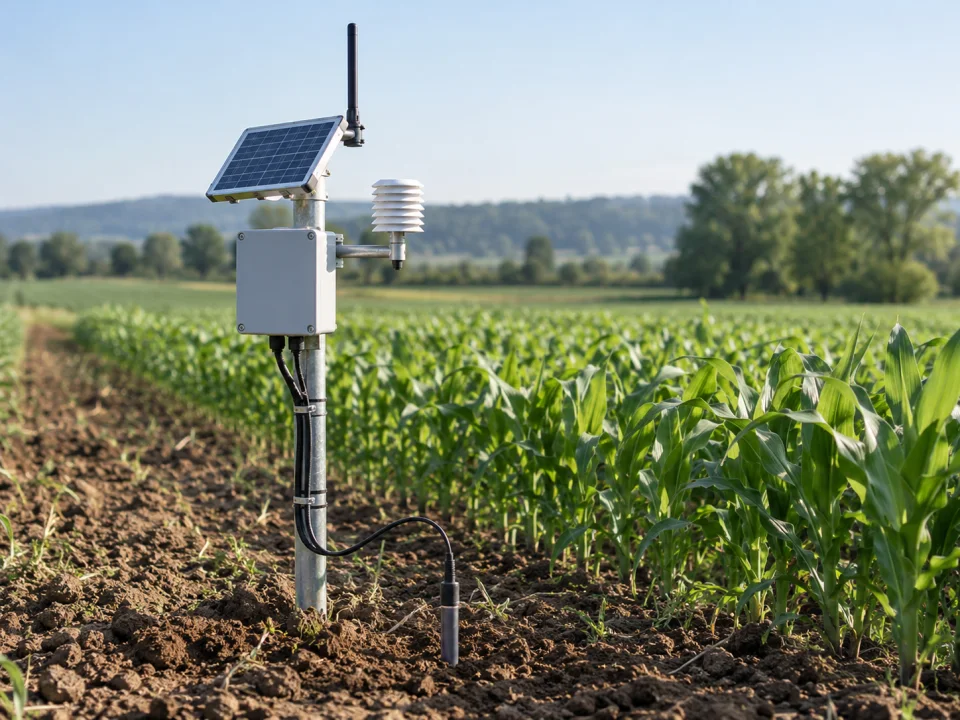
Representative application of agricultural data collection device with soil sensor connection and solar panel
Field sensor node · Representative application
04

Livestock farming, feed management and agricultural storage

Devices that monitor water consumption, feed bin level, ambient temperature and equipment operating status can be developed in livestock facilities. Reading the weighing cell on the feed mixer, showing the recipe steps to the operator, or recording the actual feeding cycle are separate project scenarios. Since mechanical assembly, movement and electrical noise can affect the result in weighing, board design is considered together with the placement on the machine.

For grain silos, agricultural stores and cold rooms, measurement points, product conditions and maintenance access are defined. Temperature, humidity and other readings from suitable sensors can be logged with time and location. Alarm thresholds, recipients and delays are specified. Scope is based on measurable technical functions, rather than claims that one sensor automatically determines spoilage, disease or yield outcomes requiring agricultural expertise.

05

Designing LoRa, 4G, local displays and server software together

LoRa based network for distributed fixed sensors, 4G telemetry for moving machine or Wi-Fi options within the facility are compared based on need. Terrain structure, antenna placement, operator coverage, data frequency and energy go into the same evaluation. The duties of the wired CAN or RS485 connection within the equipment and the internet connection are separated. The existence of a communication technology alone does not ensure uninterrupted data flow from the device to the server.

The local display must show the necessary operating information even when there is no connection. A data model is prepared on the server for device identity, machine and field matching, user authorizations, historical measurements and events. It is determined where the records will be kept during the outage and how they will be synchronized upon reconnection. If the customer has existing software, API scope, authentication and data ownership are clarified; Access to commercial producer platforms is also examined separately with permission and relevant service terms.

06

Mechanical protection, prototype and real use trials

Field devices face sunlight, rain, condensation and maintenance-access requirements; machine-mounted devices particularly face vibration, cable strain and supply variations. Enclosures, PCB mounting, sensor connections and antenna position are designed together. 3D prototypes can assess assembly and service access; moulds and production methods are considered separately for mass production. Environmental protection cannot be inferred from enclosure selection alone; the completed device needs a validation plan.

Pilot scenarios cover reference measurements, connection loss, sensor disconnection, power interruptions and restarting. Prototype results are recorded with the date, software version and hardware revision. Prototype PCB manufacturing and assembly support are provided only for customer projects developed by VOMRO. Seasonal effects on the pilot schedule are also planned, defining the evidence needed to progress from bench trials to field decisions.

07

Confidentiality, your own brand and project file delivery

Before technical details, we work with a confidentiality agreement (NDA) upon your request. Product idea, business processes and customer data are evaluated within the scope of the project. We do not offer the customer projects we develop as a product in the VOMRO sales catalogue. You can start the collaboration with the field problem you want to solve, the existing machine or facility knowledge and the usage you expect; Not all technical decisions need to be made in advance.

Source codes, electronic schematics, PCB design files, mechanical CAD files and technical documents developed within the scope of the project are delivered at the end of the project. The delivery list for compilation and programming steps, interface descriptions, test records and production files is determined from the beginning. Third-party libraries, protocol stacks, and manufacturer documentation are subject to their own license terms; It is not assumed that their rights are transferred unconditionally. This creates a usable and traceable project package for the customer's own team.

How it works

A clear process from start to delivery.

Not every project looks the same; however, the measurable requirement, controlled revision, and field verification steps remain unchanged.

  1. 01

    We define the field process

    We collect the machine, measurement, operator and target output in the same requirements list.

  2. 02

    We build architecture

    We determine electronic, communication, mechanical and software interfaces.

  3. 03

    We confirm with the pilot

    We evaluate reference measurements and outage scenarios in real use.

  4. 04

    We hand over the source files

    We deliver the source, design and technical documents for the approved revision.

Frequently asked questions

Before starting the project

The technical scope, deliverables and test plan are clarified together according to the requirements of your project.

Are you only developing irrigation and greenhouse projects?

No. Sowing and planting, soil processing, spraying, fertilization, combine harvesters and other harvesting machines, baling and feed equipment, animal husbandry and storage devices can also be evaluated within the scope of the project. We explain the application groups in detail on our agricultural machinery electronics page. Functions and connection to the existing system are examined separately in each project.

Can you develop an agricultural technology product for our own brand?

Yes. Together we determine the scope of electronics, software, mechanics, prototype and production preparation. VOMRO is the engineering service provider that develops your customer project; We do not create catalogs for the sale of ready-made products.

Can any data be obtained from the existing agricultural machine?

Data access depends on the brand, model, electronic architecture and authoritative document. Whether the desired signals are available on the relevant interface is determined by technical examination. Data and control powers not provided by the manufacturer are not considered available from the start.

Can we work under an NDA and receive the source files?

Yes. We can work with NDA before technical sharing. We deliver the source codes, PCB and mechanical designs and technical documents developed within the scope of the project at the end of the project; Third party licenses are stated separately in the delivery list.

Let's start with your idea

Let's talk about the product you dream of and the need you want to solve.