

From shelf labels to central price management

Battery-powered, remotely updated electronic shelf label system

We develop electronic shelf label (ESL) systems that centrally update product and price information on retail shelves. Battery-powered e-paper labels, wireless communication, gateway devices and management software are developed within the same project. Together, we define the board, embedded software and integration scope for your retail operation or a product developed under your own brand.

Wireless electronic shelf labels showing product prices on retail shelves
LabelBattery-powered e-paper display
ManagementGateway and central software
ProjectBoard, firmware and integration

Your project, your product

Developed confidentially and delivered with source files.

We may work with a confidentiality agreement (NDA) before sharing technical details. At the end of the project, we deliver the source codes, design files and technical documents we have developed to you.

  • NDA before sharing technical information
  • Clear deliverables agreed at the outset
  • Source and technical files at the end of the project
Our confidentiality and delivery process

VOMRO engineering approach

The right product, the right label and traceable updates

Matching each label to the correct product is as important as the display in a digital price label project. Product codes, shelf locations, displayed prices, promotions and unit information are defined together with the business data source.

VOMRO provides custom electronic shelf label development services. We establish the prototype scope around label quantities, display size, update frequency, store layout and your existing software. Design, software, mechanical enclosures and pilot tests are planned together.

01

Readable product information at the shelf edge with e-paper

An e-paper display can retain a written image without a continuous power supply to the screen; changing the image requires energy. Display size, colour options, character size and refresh behaviour are selected for readable product information. Fields such as price, product name, unit information and barcodes can be arranged in the display template.

Shelf mounting, display protection and battery access are part of the mechanical design. Display and enclosure suitability are assessed separately for labels used on standard shelves, in refrigerated sections or under different lighting conditions.
02

A measured energy budget for battery-powered shelf labels

Display technology alone does not determine battery life. Sleep current, radio listening time, display refreshes, retransmissions, battery capacity and ambient temperature are calculated together. Wake intervals, task durations and low-battery behaviour in the custom PCB and embedded software are developed around this budget.

Current consumption is measured under different update scenarios on the prototype. A fixed lifetime in years is not specified without a defined usage profile; battery replacement and maintenance tracking are included in the operating plan.

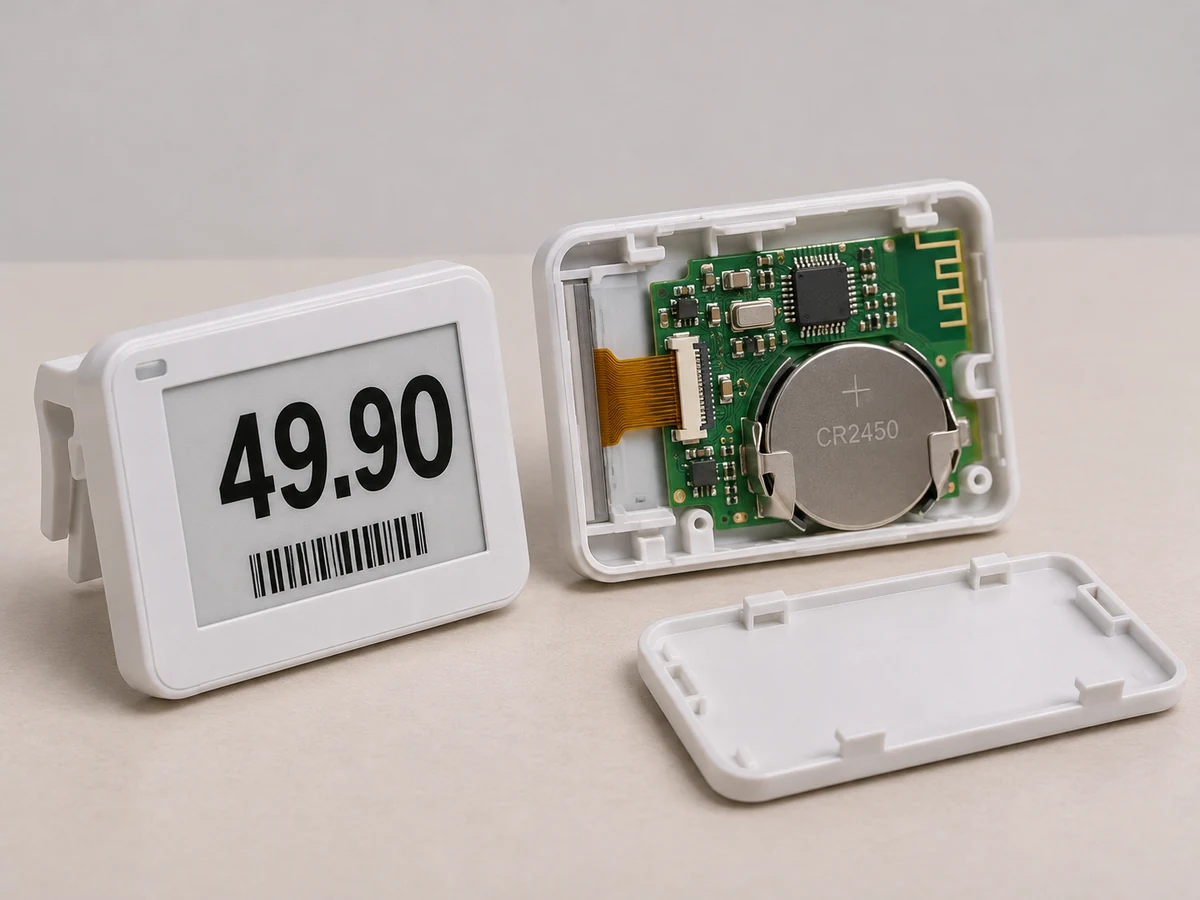
Electronic shelf label hardware with an e-paper display, battery and custom control board
03

Wireless gateways and update status tracking

Labels communicate with an in-store gateway through the selected wireless architecture. Bluetooth LE-based ESL and other low-power solutions are evaluated against coverage, device count, update targets and interoperability needs. The effects of shelving, metal surfaces and layout on communication are tested in the store.

A price change on the server does not by itself show that the shelf label has refreshed. Transmission, device responses, the last successful update and unresponsive labels are tracked separately. Retry rules are defined, while the last price that may remain on the display after connection loss and the operator warning are considered together.

04

Controlled integration with POS, ERP and price management

The price source, product code mapping and approval responsibility for changes are defined at the outset. The supported API or data transfer method of the existing POS, ERP or inventory software is reviewed. Integration is scoped for systems with an available technical interface and the required access permissions.

Scheduled promotions, unit pricing information, branch selection and bulk updates can be added to the management panel as needed. Comparison of checkout and shelf data, failed transfers and rollback scenarios are included in the pilot acceptance plan.

05

Authorised price changes and device management

User roles, store permissions, device identities and activity logs are included in the management software scope. Enrolling labels, assigning them to other products and decommissioning them follow a controlled workflow. The authentication and encryption features of the selected communication technology are used appropriately within the product architecture.

If remote firmware updates are required, package validation, version compatibility and recovery from failed updates are planned. On-premises or cloud deployment, backups and operational responsibilities are defined together with the customer’s infrastructure.

06

From a pilot store to delivery of your custom product

The pilot tests different shelf locations, bulk price changes, connection loss, low batteries and reassignment scenarios. Display readability, update status and energy measurements are evaluated together. The rollout decision is based on agreed acceptance results under actual store conditions.

The cost of an electronic shelf label system depends on development scope, display and label quantities, gateway placement, integration and testing needs. We can work under an NDA. Software source code, schematic and PCB source files, mechanical designs and technical documents developed within the project are supplied according to the agreed delivery list.

How it works

A clear process from start to delivery.

Not every project looks the same; however, the measurable requirement, controlled revision, and field verification steps remain unchanged.

  1. 01

    We define the requirements

    We determine label quantities, displays, the price source and store conditions.

  2. 02

    We prototype the label

    We develop the board, display, battery and wireless software together.

  3. 03

    We test in the store

    We validate coverage, updates and power consumption on pilot shelves.

  4. 04

    We hand over the source files

    We deliver the source files and technical documents for the approved version.

Frequently asked questions

Before starting the project

The technical scope, deliverables and test plan are clarified together according to the requirements of your project.

How many years does an electronic shelf label battery last?

Battery life depends on the battery, temperature, update frequency and communication conditions. Consumption measured on the prototype is evaluated against a defined usage profile.

Does the shelf price disappear when the internet connection fails?

E-paper can retain the last image. Delivery of a new price depends on the local network and server architecture; connection-loss and stale-price warnings are planned separately.

Can the system connect to our existing retail software?

The software API, data transfer methods and access permissions are reviewed. Product mapping and the update workflow are developed together around the supported interface.

Can we develop an ESL product under our own brand?

Yes. We can prepare a custom product development project by defining the scope of electronics, firmware, enclosures, gateways and management software.

Let's start with your idea

Let’s develop electronic shelf labels for your store.

Share the label quantity, display requirements, store layout and the system that manages your price data. Let’s define the pilot and integration scope together.