Technical decision guide · Prototype and production

Managing product development costs from prototype to series production

While your product's sales potential and market fit become clearer, we support suitable designs with FDM/filament 3D printing, high-detail SLA/resin printing, silicone mould casting and sheet-metal fabrication with press-brake forming. When demand and design mature, we assess tooling investment and series production against total cost. At VOMRO, electronics, software and mechanical development share the same production plan.

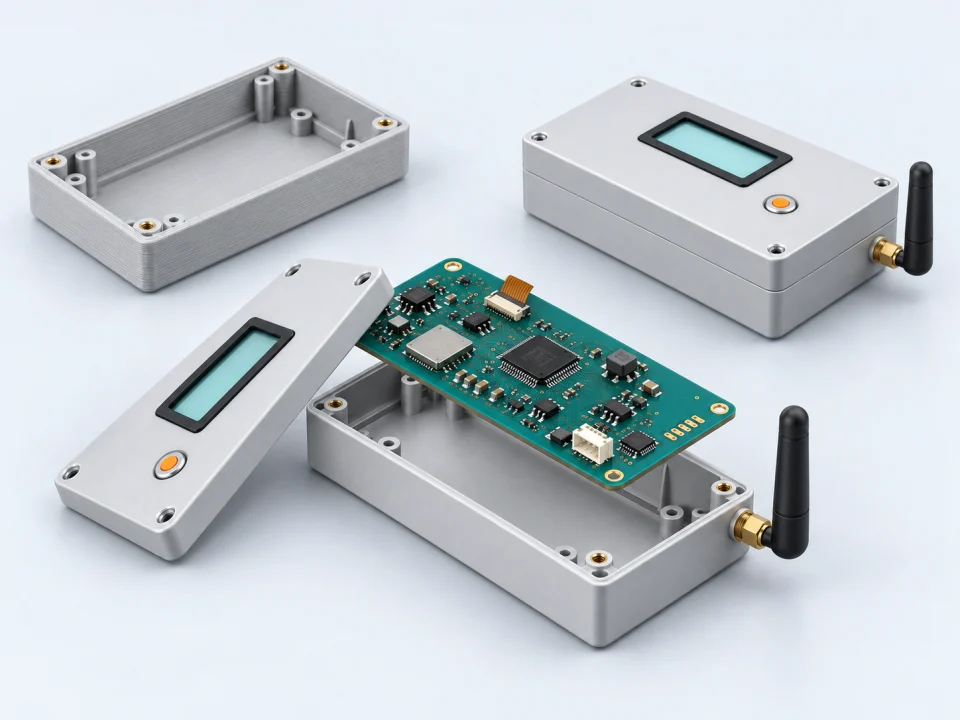
Development of the electronic device with LCD display and Wi-Fi antenna from prototype to production with body, PCB and cover parts.
representative application
BeginningUse and function to be verified
DecisionTotal cost and design maturity
TransitionFrom pilot findings to production plan

VOMRO engineering approach

The correct investment order depends on the evidence needed for the next decision.

Let's consider a device with a LCD display, a custom electronics board, a small Wi-Fi antenna, and a two-piece box. The first question may not be which method to replicate the box cheapest. Screen readability, board fit, antenna placement, and how the user will actually use the device may yet vary. While these uncertainties exist, it is necessary to answer the right question with the right prototype instead of creating an expensive change burden.

Managing product development cost means sequencing investment according to design maturity, repeat-production needs, feedback and test results. VOMRO progresses the customer's project through functional prototypes, integrated devices and, where needed, low-volume pilot production. These methods need not follow a fixed order: some projects require early sample moulding with the actual thermoplastic or tooling trials to validate material behaviour. The objective is to support production decisions with evidence of use, demand and technical feasibility.

01

Determine what uncertainty the first prototype will reduce

The first sample need not be a fully featured product. A volume model may be needed to assess LCD viewing angle and enclosure size, while a functional prototype may test measurement and Wi-Fi data transfer. These have different acceptance criteria. Features that will not yet be tested should not inflate the budget of the same phase.

We put an open question in front of each step: Do the board and display fit into the body, can the user read the information, does the antenna establish the expected connection in the selected location? It is determined which sample and which test will be used to get the answer. Priority is given to issues that will require the most rework if changed.

  • First write the risk and the question to be verified
  • Match prototype scope to acceptance condition
  • Link next investment decision to test finding
02

Compare total product cost

The cost of printing or casting a body is only a portion of the total project cost. Electronic design, embedded software, mechanical revisions, prototype material, assembly, programming, testing and, if necessary, external verification studies are included in the same budget. Packaging, wastage, reprocessing and service expectations in production are also evaluated.

In the example device, a cheaper box may require an additional part to secure the screen or a lengthy assembly process. While a unified design simplifies assembly, it can complicate the manufacturing method. Wiring harness, connector and standard fasteners are also included in the calculation. It is necessary to track one-time development expenses and recurring expenses separately on each device. When the resources required for design changes and retesting are visible, it is more accurate to evaluate what the option with a low unit price actually brings.

  • Compare offers with the same technical scope
  • Separate one-time and recurring expenses
  • Calculate the impact of assembly, testing, revisions and servicing
03

Evaluate the design with FDM and SLA 3D printing before investing

3D printing allows new samples as enclosure dimensions and part layouts evolve. FDM filament prototypes can help assess board placement and mating-feature revisions, with layer orientation evaluated for its effects on strength and surface quality. SLA resin printing can target fine detail and presentation-quality surfaces through suitable materials and process settings. The physical sample checks the LCD frame, lid joint, button spacing and screw positions. Build orientation, support placement, cleaning and post-curing are included in the assessment.

High detail quality does not mean that all mechanical conditions are met. Resin selection, data sheet and manufacturer process conditions should be reviewed based on intended use. Separate verification is required for impact, temperature, flex, or outdoor expectations. The model that confirms the appearance of the cover in the sample device and the model that will be tested for long-term use may not require the same material. The material and process information of the measured sample are recorded. When the production method is started, critical seating and assembly dimensions are checked again; The result in the prototype is not automatically transferred to the final part.

  • Separate appearance, layout and function goals
  • Select resin according to usage load and process conditions
  • Verify critical measurements at every production revision
04

Consider silicone moulding and casting as a low-volume transition option

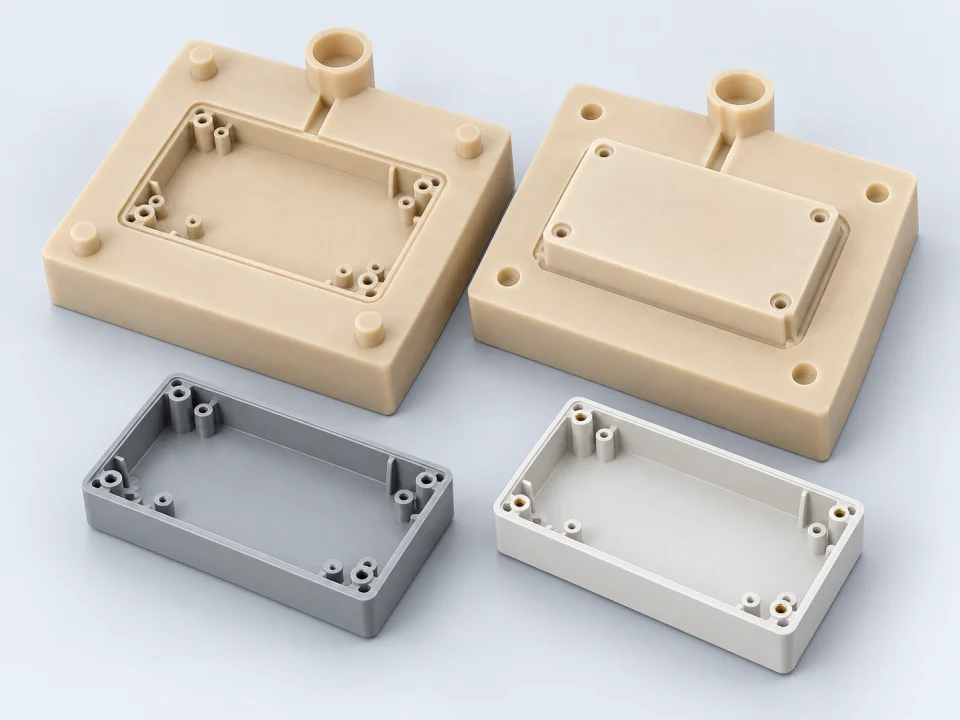
In silicone mold casting, a flexible mold is prepared from a master model and the parts are reproduced with the selected casting material. Silicone here is the material of the mold; It does not necessarily mean that the resulting box is silicone. For example, polyurethane-based casting materials can be used. Vacuum casting is a manufacturing approach in which air gaps are managed when appropriate to the geometry and material. The surface and accuracy of the master model affects the part to be duplicated.

For pilot enclosures of an LCD-equipped device, material selection considers hardness, temperature, chemical exposure, colour and surface requirements. A resin marketed as similar to an injection-moulding thermoplastic is not assumed to reproduce all its properties. Parting marks, screw features and display fit are checked on the sample. Mould life and replacement tooling must be included in the quotation. This method can support learning through small batches while the design evolves, but is not assumed to be cheapest for every project or to validate the final material for every use.

  • Define main model, mold and casting material separately
  • Take into account mold renewal, surface and assembly checks
  • Evaluate material similarity by use test
Master model, two-part silicone mould and cast copies of an electronic device enclosure with an LCD screen
representative application
05

Compare sheet metal cutting and press brake bending on suitable bodies

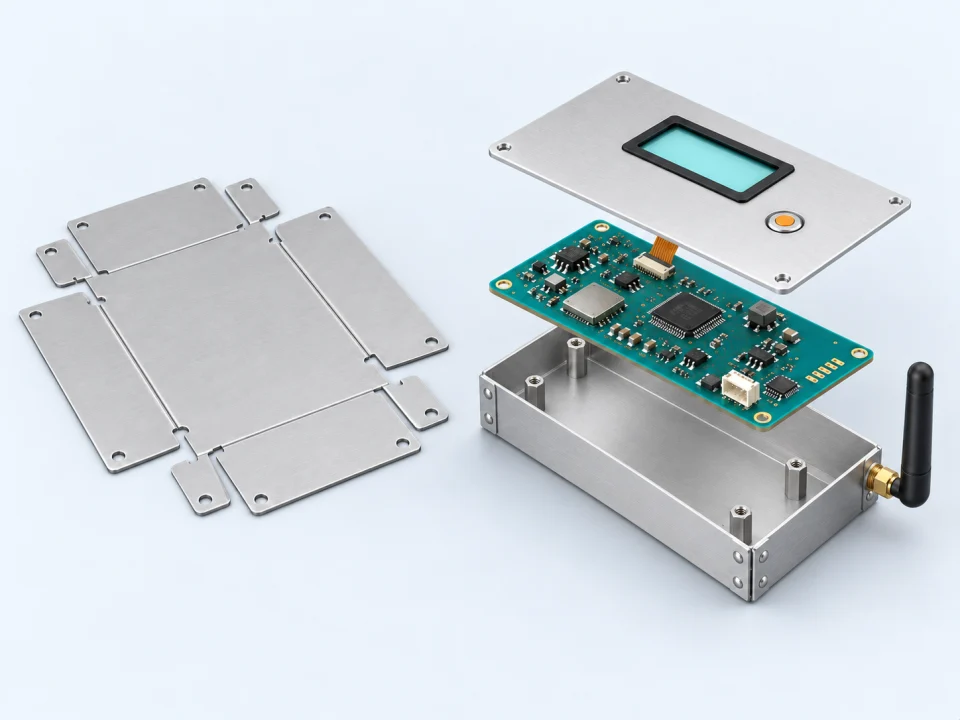
If the box, carrier chassis or mounting bracket of an industrial device is suitable for sheet metal design, cutting and press brake bending can be evaluated. This method is not an alternative to every organically shaped plastic body. Material thickness, bend radius, tool reach, distance of holes to the bend and part combinations determine the design. Surface treatment, arrangement of edges and fasteners are also included in the scope of production.

Moving the sample device to the metal body does not only change the external surface of CAD. The LCD window, the distance of the board to the body, cable passages and, if necessary, grounding connections are re-evaluated. Antenna location and connection testing are considered together, as the metal housing may change the behavior of the Wi-Fi antenna. The total quote including cutting, bending, painting, assembly and testing is compared. Critical assembly points are measured and verified on the first part.

  • Geometry and tool access suitable for sheet metal structure
  • Production quotation including surface finishing, joining and assembly
  • Antenna and electrical layout control with metal body
Cut sheet metal flat pattern, press-brake-formed device enclosure and assembly parts for an electronic board and LCD screen
representative application
06

Connect low volume production with market and usage feedback

After a single working sample, the need may be for consistent devices that a small number of users or businesses can try. The pilot batch provides information on installation time, understanding of the display, connectivity issues, maintenance need, and customer priorities. Plan how feedback will be collected and which changes will be rolled out to the next release. Commercial interest, order expectations and actual usage findings are considered different types of data.

We support the project through phases determined with the customer until sales potential and market acceptance are better understood. The pilot goal and scope are determined together; This approach does not guarantee sales or demand. For example, if the screen layout still changes on the device with LCD, it may make sense to make a decision after feedback rather than fixing the entire box investment. At the end of the pilot, a design with updated revisions and acceptance conditions is aimed.

  • Pilot user, usage and feedback plan
  • Distinguishing signs of demand from confirmed orders
  • Design and production decision updated with findings
07

Get electronics, software and production testing into the same cost plan

As the enclosure manufacturing method matures, the board and software must also progress towards production readiness. Critical components, sourcing alternatives and revisions are tracked in the bill of materials (BOM). Access is needed to program the board, assign device identity and check basic functions. The test method for functions such as the LCD, buttons, sensors and Wi-Fi is defined for every manufactured unit. Detailed development testing on a single prototype does not replace the production inspection plan.

When a chassis change affects the display cable, antenna, or board fixing, not only the mechanical file is updated; Relevant verifications are also repeated. Matching the software version with the hardware revision makes this cost visible. Connector layout and accessible test points that facilitate assembly can contribute to the production flow. PCB sample production and electronic component assembly support are only within the scope of customer projects developed by VOMRO. External testing, technical documentation and correction needs are also included in the plan, depending on the product requirement and target market.

  • BOM, supply, hardware and software revision tracking
  • Assembly, programming and production control plan
  • Renewal of relevant tests after method changes
08

Base the move to injection moulding on demand, a stable design and a complete quotation

Once design and demand are more stable, plastic injection moulding can be considered. Material, surface, tolerances, mould construction, moulding and assembly conditions are quoted together. Parting lines, draft angles, wall thicknesses, ribs and connections are reviewed for manufacturability. A previously printed or cast shape is not assumed to be suitable for injection moulding without changes. Trial mouldings and critical measurements form part of acceptance.

For a simple comparison, total cost can be expressed as T = F + N × v: F is the method's initial cost, N the quantity considered and v the recurring cost per device. For two options with the same scope, these values can identify the quantity at which their costs intersect. A decision also needs tooling changes and replacement, scrap, assembly and retesting costs. There is no universal changeover quantity. While the LCD window or board dimensions continue to change, any calculated unit-cost advantage must be reassessed alongside design-change costs.

  • Stable use requirement, design and demand evaluation
  • Offer of molds, samples, parts and assembly with the same scope
  • Acceptance of initial moulded samples and completion of relevant technical validation
09

Clarify phased scope, confidentiality and technical delivery from the start

You can share the usage of the product, current prototype status, targeted quality and production expectation to choose the next step. VOMRO evaluates electronics, embedded software, industrial design, mechanics, prototype and production preparation together. Requirements, phase deliverables and acceptance conditions are determined. Before technical details, we will sign a confidentiality agreement (NDA) upon your request; The project developed is for the customer's own product and brand.

Project source codes, electronic schematics and PCB design resources, editable mechanical CAD files and technical documents are delivered at the end of the project. The delivery list for production deliverables, BOM, compilation/programming information, and test records is created initially. License terms for third-party components and tools are stated separately. The customer is delivered a technical package that can be used in subsequent developments.

  • Initial determination of scope, phases, acceptance and delivery list
  • NDA before technical sharing upon request.
  • Delivery of source, PCB/CAD and technical documents at the end of the project
Compare the production method to the needs of the project, not to a single quantity threshold
MethodWhat decision does it help with?Evaluate the offer togetherSample acceptance control
FDM / SLA 3D printingExamination of size, detail, placement and changesMaterial, process, surface and resample needLCD fit, board assembly and selected usage testing
Casting with silicone moldReproduction of similar parts in the pilot with suitable materialMaster model, mold life, resin and finishing processesDimensions, surface finish, screw bosses and material behaviour
Sheet metal cutting / press brakeCreating a body or chassis suitable for sheet metal structureThickness, bends, surface finish and assemblyInitial part dimensions, assembly and antenna connection
Plastic injection mouldingRepetitive production in accordance with mature design and production needsMould, modifications, moulding, scrap and assemblyMoulded samples, critical dimensions and integrated device testing

How it works

Turn decisions into a project plan.

Not every project looks the same; however, the measurable requirement, controlled revision, and field verification steps remain unchanged.

  1. 01

    We define uncertainty

    We determine which function or use to verify for the next decision of the product.

  2. 02

    We develop the appropriate sample

    We choose the prototype and production method according to the scope of electronics, software and mechanics.

  3. 03

    We evaluate pilot findings

    We update the design and cost plan with testing, user feedback and demand information.

  4. 04

    We make the production decision concrete

    We complete the quotations, acceptance and technical source file delivery for the mature design together.

Frequently asked questions

Before starting the project

The technical scope, deliverables and test plan are clarified together according to the requirements of your project.

Does a new product require an injection mould from the outset?

Not every project requires a mould. Depending on design, use and demand, suitable enclosures can be assessed for FDM or SLA 3D printing, silicone mould casting or sheet-metal fabrication. Tooling decisions are based on stable requirements and total quotations covering the same scope.

Does the high quality SLA prototype meet all tests of the final product?

Surface and detail quality is not the same criterion as impact, temperature or long-term mechanical behavior. Resin and processing conditions are selected according to the intended use; The necessary tests are performed on the defined sample. The final production material is also verified.

Will the electronic box that comes out of the silicone mold be made of silicone material?

Not necessarily. Silicone mold describes the material of the tool used in reproduction. The material poured into it is selected according to the project requirement; For example, it can be polyurethane based resin. The properties of the final part are also evaluated.

At what quantity does injection moulding become more economical?

There is no one valid quantity for all products. Offers are received with the scope of geometry, material, mould, assembly, wastage, change and testing. Initial and unit expenses are compared within the same scope; The maturity of the design and demand are also factored into the decision.

Do you provide support through market feedback and deliver the project source files?

We plan the scope of pilot and phased development together; We evaluate the next step with usage and demand information. Source codes of the project, PCB and CAD design resources and technical documents are delivered at the end of the project. The list and formats are determined at the beginning.

Your project, your product

Developed confidentially and delivered with source files.

We may work with a confidentiality agreement (NDA) before sharing technical details. At the end of the project, we deliver the source codes, design files and technical documents we have developed to you.

  • NDA before sharing technical information
  • Clear deliverables agreed at the outset
  • Source and technical files at the end of the project
Our confidentiality and delivery process
Let's start with your idea

Let's talk about the product you dream of and the need you want to solve.